Mohan No Masalo
Recipe for Making a Mahatma
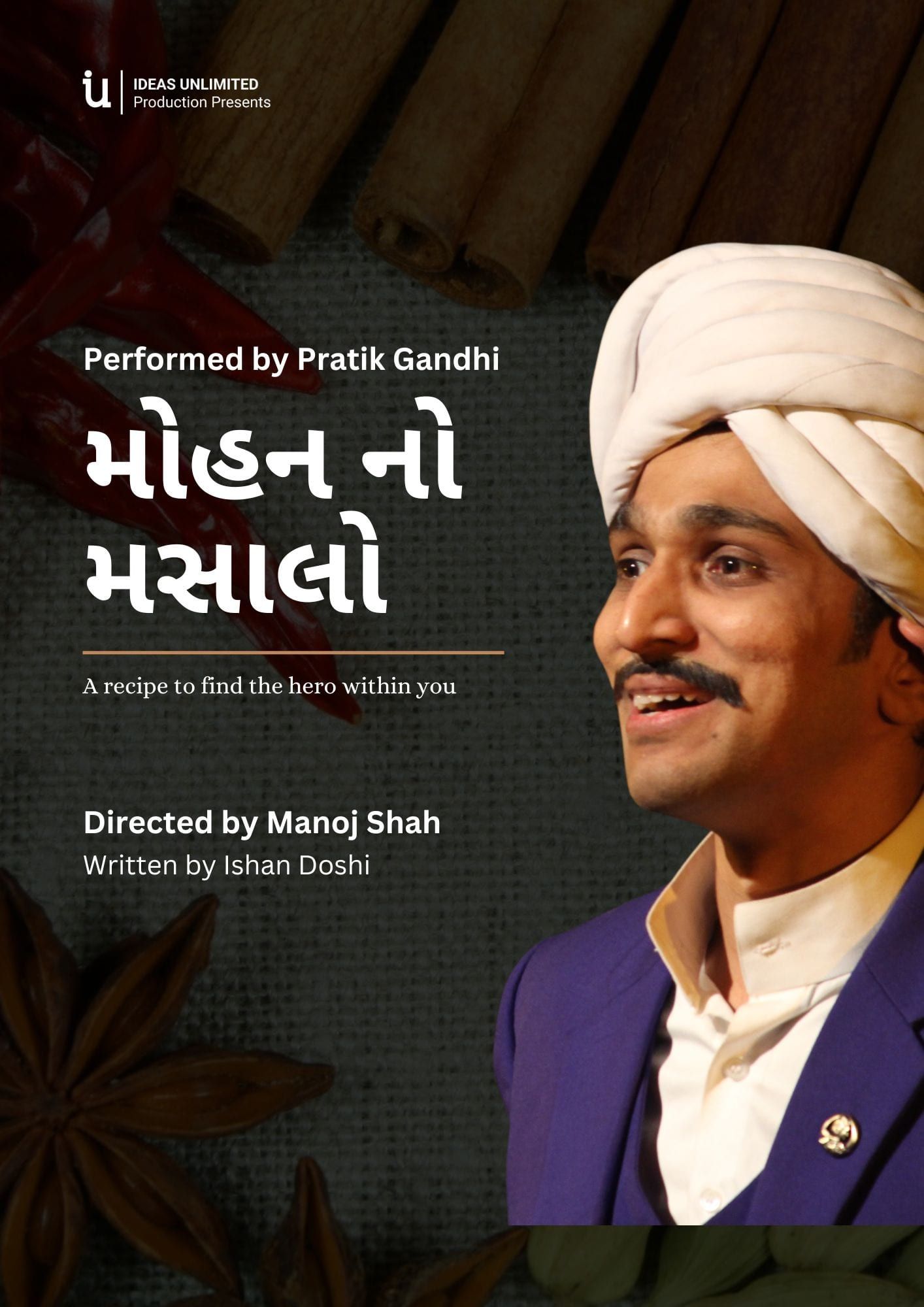
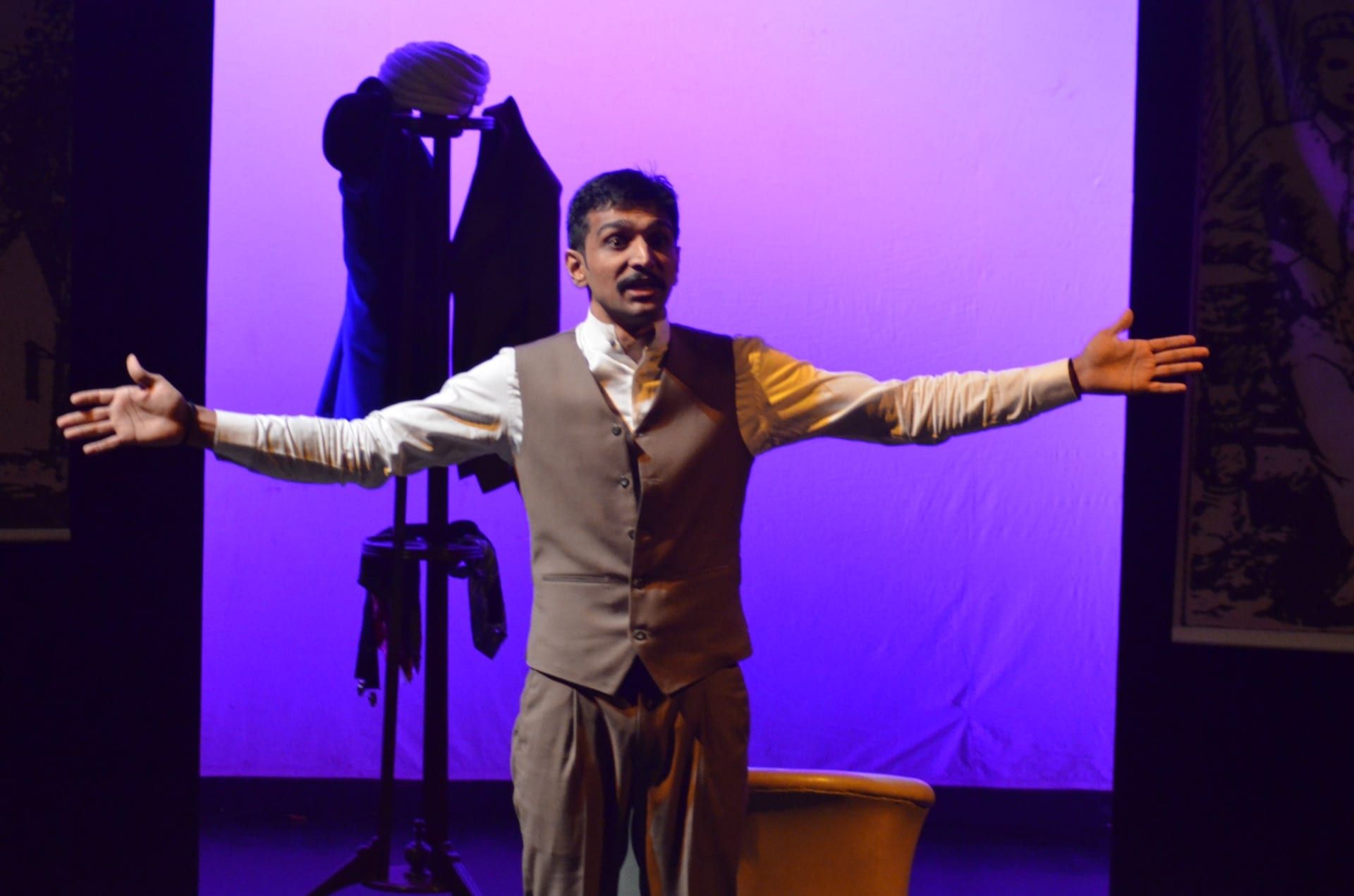
The play that entered the Limca Book of Records. The play that Pratik Gandhi performed before Scam 1992 made him famous. The play about Mohandas Gandhi before he became the Mahatma. Mohan No Masalo — Mohan’s Spices — recovers the young Mohandas: the scared boy from Porbandar, the awkward teenager who married at thirteen, the mediocre student who sailed to London to study law, the diffident barrister who failed in Bombay courts, and the accidental activist who boarded a train in South Africa and found his purpose when he was thrown off it. These are the masalas — the spices — that made the Mahatma. The recipe, told by the man himself. Pratik Gandhi performs the ninety-minute monologue alone against Atul Dodiya’s black-and-white backdrop paintings of a young Gandhi. The Gujarati script was written by Satya Mehta, the Hindi version by Mihir Bhuta and Arpit Jain, the English by Ishan Doshi. Parthiv Gohil provided the vocal performances. The play premiered on 22 March 2015 at NCPA and was subsequently performed in all three languages — Gujarati (Mohan No Masalo), Hindi (Mohan Ka Masala), and English (Mohan’s Masala) — in a single day at the same theatre by the same actor. This feat earned a Limca Book of Records entry for ‘Performance of One Play in Multiple Languages in One Day.’ Manoj Shah on why he made this play: ‘I wanted to be with youth. Best way to re-invent ideas for youth without cliché results is Mohan ka Masala.’
The People
Behind
the Play
Trailer
Press &
Reviews
The National
Manoj Shah's New Play Discovers the Early Days of Gandhi the Legend
A light-hearted one-man show about the early life of Mahatma Gandhi, rooted in fiction and performed by Pratik Gandhi in three languages — earning a Limca Book of Records entry.
22 March 2015
Mid-Day (Suprita Mitter)
Three Times the Mahatma
A play performed in three languages — Gujarati, Hindi and English — by the same actor on the same day looks set to wow all you theatre junkies.
9 June 2016
Mumbai Theatre Guide
Mohan No Masalo — Review
Mohan No Masalo is written by Ishan Doshi and directed by Manoj Shah. The young Gandhi takes you through his journey with an extraordinary quality that makes the production extraordinary. Pratik Gandhi gives a stellar performance.
1 April 2015
Gujarati Mid-Day
Ek Kalakaar, Ek Director, Ek J Natak Tran Bhashama
One actor, one director, the same play in three languages. Mohan No Masalo performed in Gujarati, Hindi, and English on Friday at Prithvi Theatre — a historic theatrical event covered with a full page in Gujarati Mid-Day.
7 June 2016
Navgujarat Samay
Ek J Kalakaare, Ek J Natak — Tran Bhashama Raju Karyu
Same artist, same play, presented in three languages. Navgujarat Samay's detailed account of Pratik Gandhi performing as young Mohandas in Gujarati, Hindi, and English — and the Limca Book of Records entry.
14 June 2016
IndianShowBiz
Popular Play 'Mohan's Masala' Comes to Mumbai
The celebrated theatre company Ideas Unlimited is coming to Mumbai on 10th June 2016 with their hit production Mohan's Masala, a mono act about young Mohandas Gandhi, starring Pratik Gandhi and directed by Manoj Shah.
8 June 2016
Sandesh
Multi-Tasking na Maharaja: Shishir Ramavat on Pratik Gandhi
Shishir Ramavat's profile of Pratik Gandhi in Sandesh — an engineering graduate and Reliance deputy general manager who balances a corporate career with starring in Hu Chandrakant Bakshi and Mohan No Masalo.
5 June 2016
Mumbai Theatre Guide (Keyur Seta)
Mohan No Masalo — Review
May not bring any particularly new insights, but there is a friendly, entertaining quality that makes the production enjoyable. Pratik Gandhi has raised his standard — his remarkability is on display.
15 April 2015
Mint (Vikram Phukan)
Gandhi: A Stage Favourite
Mohandas Karamchand Gandhi continues to fire the imagination of writers everywhere. In Manoj Shah's Mohan No Masalo, Pratik Gandhi plays the young Mohandas with a friendly, entertaining quality against Atul Dodiya's paintings.
20 August 2016
CreativeYatra
An Inviting Flavour: Mohan No Masaalo
Pratik Gandhi's portrayal of the young Mohandas is both entertaining and enlightening, revealing the human behind the Mahatma through the metaphor of masalo — the spices of experience.
30 January 2017
Chehra Mohra (Utpal Bhayani)
Mahatma na Mooliyaan Dekhado — Mohan No Masalo
The roots of the Mahatma shown through Mohan No Masalo. Utpal Bhayani's Gujarati review traces how Manoj Shah's play recovers the ordinary Mohandas before the extraordinary Mahatma — and argues this is exactly the Gandhi today's youth needs.
1 May 2015
Gujarati Review
Mohan No Masalo — Review by Divyasha Doshi
My tailor is the only man who behaves wisely — he takes my measurements afresh each time. This play does the same with Gandhi: it measures the man anew, from angles we never considered.
1 June 2015
Gujarati Review
Mohan No Masalo — Review by Hemant Karia
After watching Mohan No Masalo, one wants to say: this is Manoj Shah's Mohan — just as we once said 'Attenborough's Gandhi.' If an ordinary Mohan could become Gandhiji, why can't one of us?
15 May 2015
Also Worth
Seeing

Dr. Anandibai
Like, Comment, Share
The first woman to perform a solo role in a Manoj Shah production — and the first Indian woman to earn a medical degree. Two firsts, separated by 131 years. Dr. Anandibai Gopalrao Joshi was married at nine, widowed of her infant son, and told by every institution around her that a woman's place was in the home. In 1886, she sailed to America and earned her MD from the Woman's Medical College of Pennsylvania — the first Indian woman to do so. She returned to India to serve as the physician-in-charge at the Albert Edward Hospital in Kolhapur. She was twenty-one. She died of tuberculosis the following year, at twenty-two. Written by Geeta Manek and directed by Manoj Shah, the play uses the conceit of social media — Like, Comment, Share — to draw parallels between Anandibai's 19th-century struggles and the pressures facing Indian women today. Are they still defined by the likes they receive? Still waiting for male validation? Still weighed down by domestic duty disguised as devotion? Manasi Joshi performs the 75-minute monologue alone on a bare stage — no props, no set, just Kabir Thakore's spatial design and Hemant Joshi's lighting carving the world out of darkness. The play premiered at NCPA's CentreStage Festival on 2 December 2017, opened in Hindi at Bhavan's College and in Marathi at the Damu Kenkre festival in 2018, and was selected for the 8th Theatre Olympics that same year.
Hu Chandrakant Bakshi
I, Chandrakant Bakshi
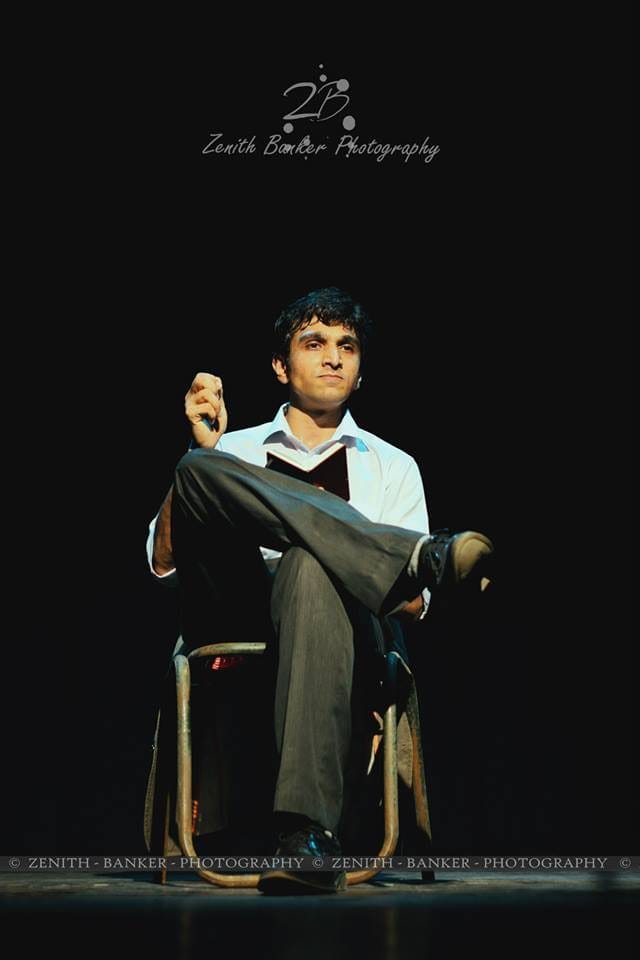
The story of Gujarati literature's most controversial writer, told by the man himself — or rather, by Pratik Gandhi inhabiting him with a ferocity that made audiences forget they were watching an actor. Chandrakant Bakshi (1932–2006) authored 178 books, served as Professor of History, became Sheriff of Mumbai, got his short story 'Kutti' banned by the Gujarat government, publicly defied Bal Thackeray and refused to apologise, and wrote an autobiography so incendiary that parts of it could not be published. His writing style — Gujarati laced with Urdu, Hindi, and English — was as deliberately provocative as his public persona. He was, by every account, an incredible egoist. He was also, by every account, adored by his readers. Written by Shishir Ramavat and drawn from Bakshi's autobiography Bakshinama, the play premiered on 15 June 2013 at Prithvi Theatre. Manoj Shah uses a ladder throughout the production as a metaphor for Bakshi's obsession with being on top. Gandhi — years before Scam 1992 would make him a household name — delivers what CreativeYatra called a 'cautious yet fearless' performance, bringing the bold and egotist protagonist to 'flawless perfection.' This play, along with Mohan No Masalo two years later, is credited with solidifying Pratik Gandhi's reputation as an actor of immense talent.
Gathariya
Kaleidoscope
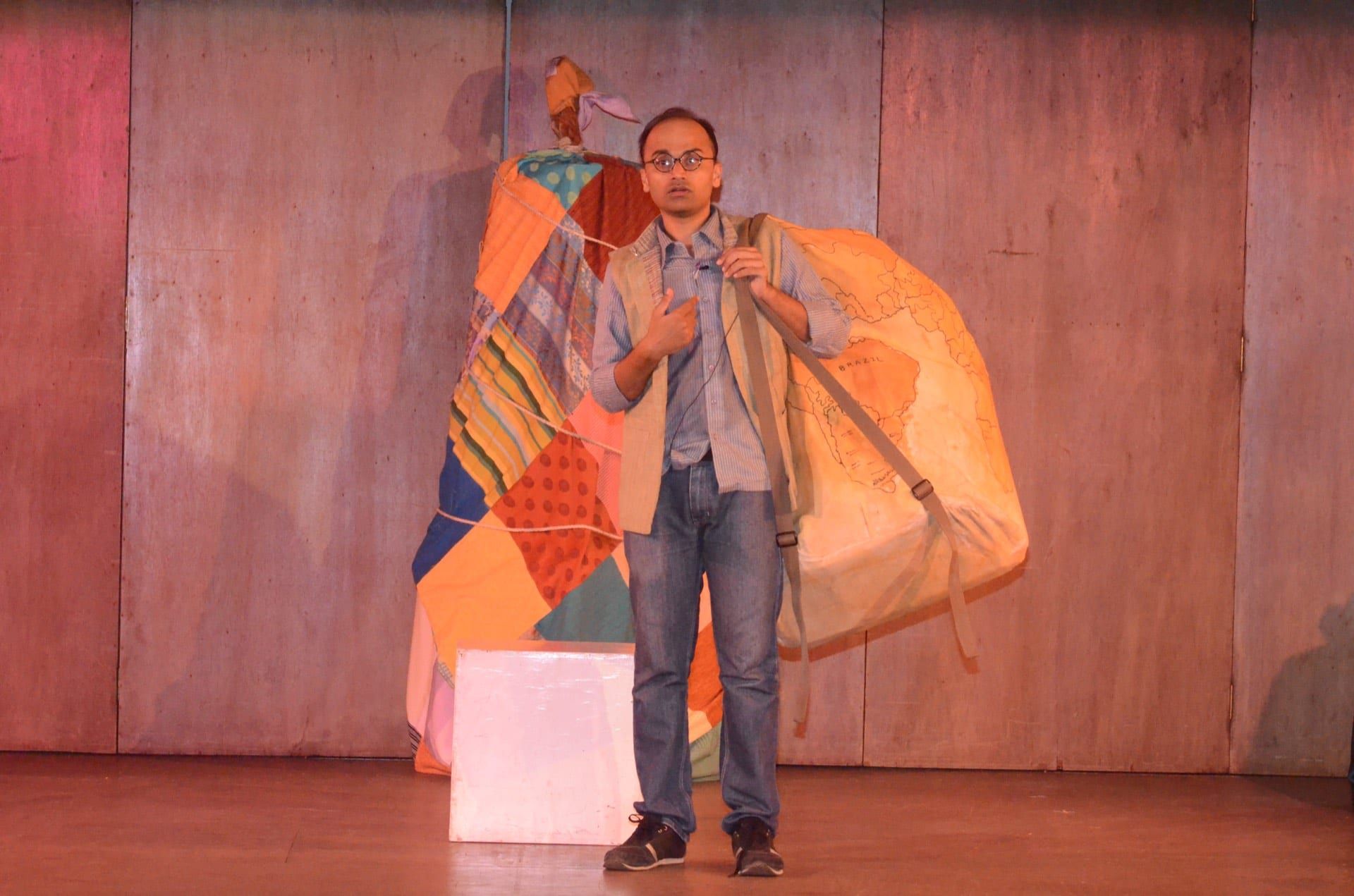
Chandravadan Chimanlal Mehta — Chan. Chi. Mehta to everyone who read him — spent his life packing and unpacking. He was born in Surat in 1901, schooled in Vadodara and Surat, wrote more than twenty-five plays including Agagadi, joined Gandhi at the Bardoli Satyagraha in 1928, taught at New Era High School in Bombay, went into All India Radio in 1938 and ran its Ahmedabad station, started the first diploma and degree courses in theatre in India at M. S. University in Baroda, and travelled — Europe, America, theatre after theatre — until the travelling became the writing. The twelve volumes he made of it are all called Gathariyan: bundles, the cloth-tied bedroll a traveller slings over one shoulder. Bandh Gathariyan. Chhod Gathariyan. Safar Gathariyan. Natya Gathariyan, the one on theatre, took the Sahitya Akademi Award in 1971. Manoj Shah's play takes the title and the image literally. Pulkit Solanki plays Mehta alone on a bare stage with two bundles: one stitched out of patchwork the height of a man, one painted as a map of the world. He unties them and the life comes out of them in no particular order — a doll made for a child, a name given, the first day of school and the first punishment in it, a marriage he did not want, a train to Surat, Uttarayan kites over the roofs, Bardoli, a film projector, the Ila poems that move without warning between nursery rhyme and elegy, Vande Mataram, Bach's St Matthew Passion, New York jazz, and the long way home. Kanti Patel wrote it; Satya Mehta made the dramatisation; Kanhaiya's fifty-two-cue score carries the century the way the bundles carry the luggage. The play is subtitled Kaleidoscope, and it earns the word. There is no chronology to hold on to and no second actor to play against — only a man, his luggage, and Shekhar Phadke's light finding him in it. What holds is the voice: the appetite of a man who wanted to see every stage on earth and then tell Gujarat about it in Gujarati. It premiered at the Godrej Dance Theatre at the NCPA, Mumbai, at four in the afternoon on 27 March 2016 — World Theatre Day, the observance Mehta's own record says he moved the resolution for at the International Theatre Institute's congress in Vienna, under UNESCO. It later played Prithvi Theatre, Juhu.
Popcorn with Parsai
Harishankar Parsai Alive
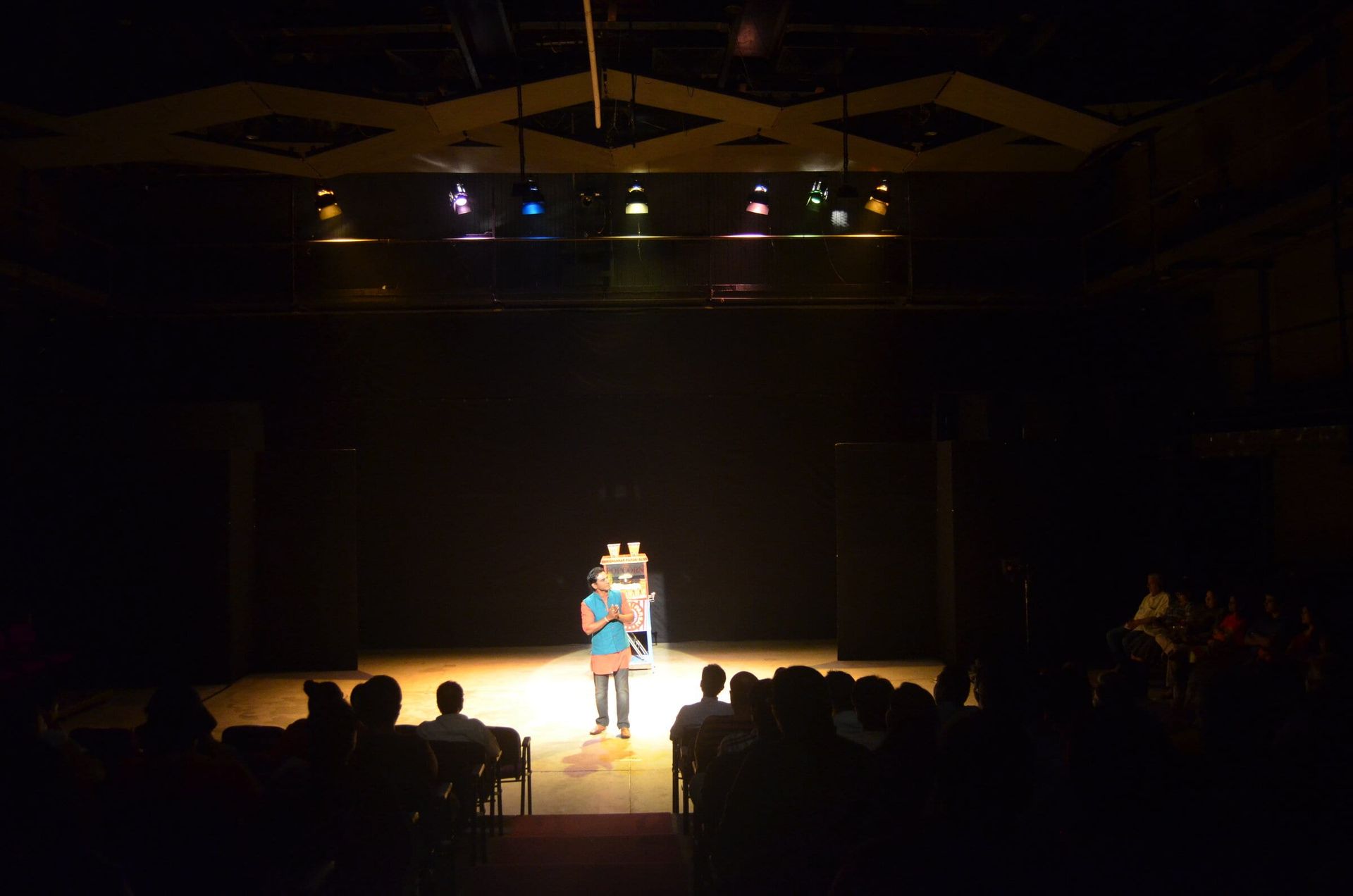
A popcorn cart is wheeled onto an empty stage. It is the kind you see outside a cinema — striped red and white, glass box, bicycle wheels, paper cones stacked on the roof — except that the hoarding across its top does not advertise popcorn. It reads HARISHANKAR PARSAI ALIVE. One man comes out, and for the next hour he sells you the collected works of modern Hindi's fiercest satirist the way a vendor sells snacks at the interval: a fistful at a time, salted, cheap, and impossible to stop eating. Harishankar Parsai (1924–1995) is the writer who made vyangya — satire — a form Hindi literature had to take seriously. He was born at Jamani near Itarsi in Madhya Pradesh, took an MA in Hindi at Nagpur, and then spent his whole working life in Jabalpur, where he founded the literary magazine Vasudha, watched it close for want of money, and answered readers' questions in Deshbandhu under the standing headline Poochhiye Parsai Se — Ask Parsai. He wrote in a plain, flat, unliterary Hindi that gave him room to be merciless. A dead clerk's soul gets stuck in government red tape in Bholaram ka Jeev. A policeman is sent to the moon to teach the lunar force Indian methods in Inspector Matadeen Chand Par. Premchand ke Phate Joote takes a photograph of India's greatest novelist in torn shoes and turns it into an argument about what the country does to its writers. Viklaang Shraddha ka Daur won him the Sahitya Akademi Award in 1982. He was a man of the Left who spared the Left nothing, and two generations of Indian schoolchildren have met him in their NCERT textbooks without ever quite realising what they were reading. Nilay Upadhyay's script does not narrate that biography. It puts the writing in the vendor's mouth and lets the man assemble himself out of his own sentences — funny enough to make you laugh, as the production's own line had it, serious enough to prick your conscience. Manoj Shah directed it as a fantasy on a bare floor: a cart, a folding chair, a light, and Dayashankar Pandey. Pandey — Goli in Lagaan, Inspector Chalu Pandey in Taarak Mehta Ka Ooltah Chashmah — is on stage from the first second to the last with nobody to play against, and the whole architecture of the evening rests on how fast he can change register: vendor, clerk, policeman, poet, the dead man arguing with a file. He has called it a dream role for any actor. It opened at the NCPA in Mumbai on 6 December 2014 and went on to run forty-eight shows, all of them housefull, travelling with a company of six — Surat's Science Centre in November 2015, Prithvi Theatre on 10 February 2016, and on from there. The poster carried a green vegetarian mark and the line “recommended for age 9+”, which is a joke, and also true.
What's Up?
One Man, One Flight, Too Many Calls
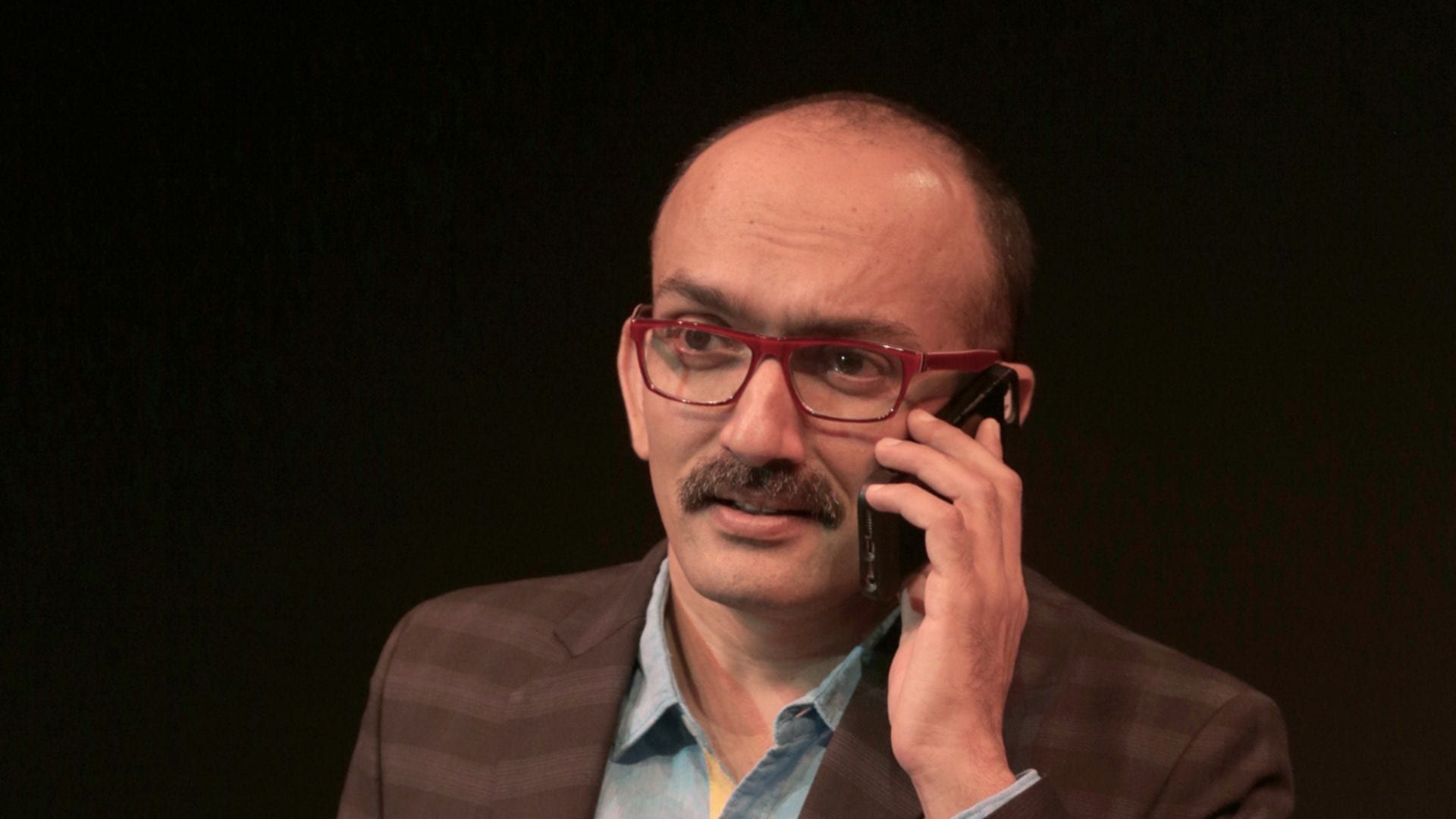
Meet Chirag — a perfectly average man in his early thirties with a single, noble mission: catch a flight to Chicago and save his not-so-bright brother from being thrown behind bars for a minor misunderstanding. But before he can zip up his suitcase, his girlfriend drops a bombshell. His phone starts ringing like it owes someone money. On the other end: his sister’s in-laws, an elite task force of relentless, nitpicking, drama-fuelled wedding planners who believe that unless Chirag approves the saree border and the sambharo menu, the marriage might as well be cancelled. From that moment, Chirag’s day turns into a high-stakes obstacle course complete with passive-aggressive aunties, conspiracy theories on family WhatsApp groups, emotional blackmail disguised as wedding prep, and the looming threat of missing his flight. He’s stuck between love and loyalty, Google Maps and Google Calendar, chai breaks and breakdowns. Written by Uttam Gada and directed by Manoj Shah, What’s Up? is a riotous solo comedy performed by Chirag Vohra — the original lead of Master Phoolmani. It premiered at NCPA’s CentreStage Festival in November 2015 and perfectly captures the madness of trying to keep everyone happy when no one knows what they actually want.
Sikka Ni Triji Baaju
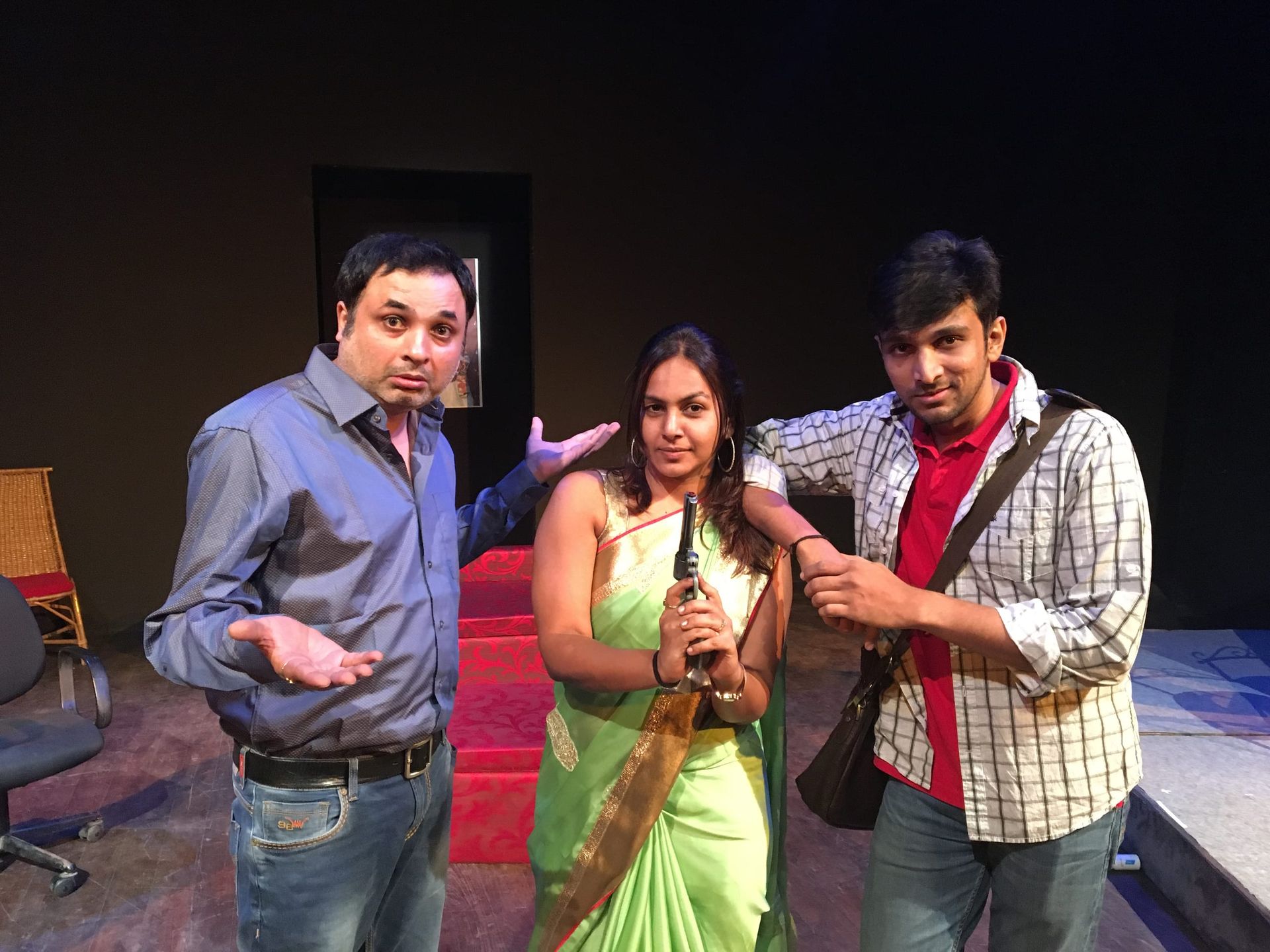
Sikkani Treeji Baju (The Third Side of the Coin) is a 110-minute thriller-comedy in Gujarati, written by Naushil Mehta and directed by Manoj Shah. Adapted from Chazz Palminteri's play Faithful, it is a sensuous thriller on the fragile themes of marriage, men, and money — with unexpected dollops of humour. Madhvi is the wife of multimillionaire diamond exporter Arvind Kothari. She lives in a secluded sea-facing bungalow in Mumbai. On a rainy day when she is home alone, Dhiru ‘Sixer’ — a top hit-man — manages to enter and overpower her. As Dhiru waits impatiently for his client's signal to kill her, Madhvi sits tied to a chair, realising she has only moments to save herself. Who wants Madhvi dead? Why? Is Madhvi able to find a way out of this predicament? Is Dhiru really the killer he claims to be? Is Arvind really Dhiru's client? The answers arrive with increasingly slippery footing, and the play slides between thriller and farce often in the same line. The third side of the coin, the one no one looks at, turns out to be the only side that matters.