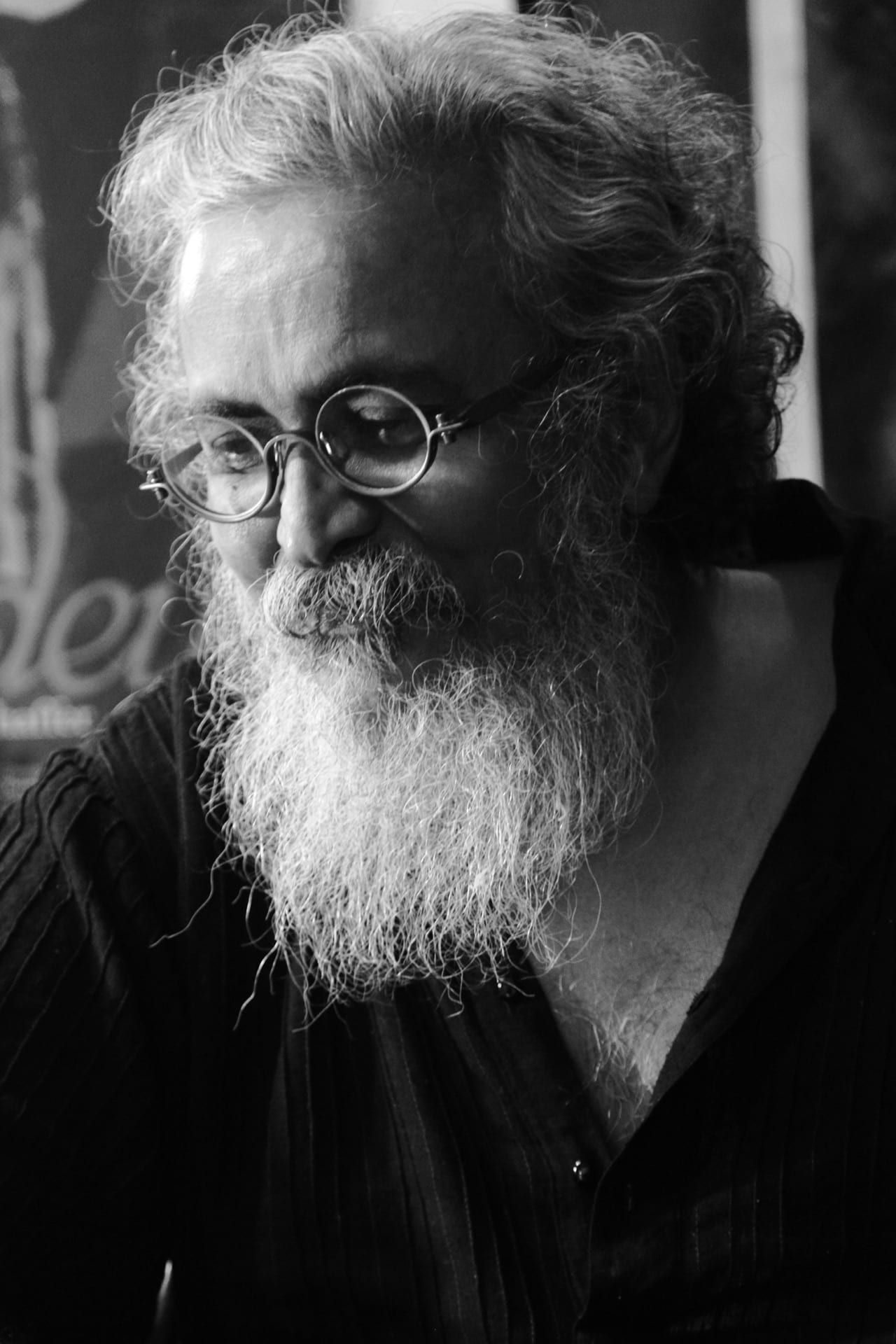
Manoj
Shah
Director
Actor
Producer
Founder, Ideas Unlimited
Born 5 February 1955 · Mumbai · 96+ productions · 25+ years
Before the Stage
Manoj Sakarchand Shah was born in Mumbai and studied until the ninth grade at schools in Mumbai and Ahmedabad. He began working as a dance teacher. Then he watched a play directed by Mahendra Joshi, and something shifted. He started acting. He studied the work of Badal Sircar, Utpal Dutt, and Vijaya Mehta. He read Jean Tardieu, Samuel Beckett, August Strindberg, Peter Handke, Robert Patrik, Chekhov. He performed in street plays, experimental theatre, cafe productions. He worked as an actor and extra in films, crossing paths with Richard Attenborough, Ketan Mehta, Piyush Shah, and Navroze Contractor.
None of it was enough. He wanted to direct. On 15 November 1999, at Horniman Circle Gardens during the Prithvi Theatre Festival, he staged his first production: Master Phoolmani. He was forty-four years old.
Master Phoolmani and the Bhangwadi Tradition
Master Phoolmani was adapted from Satish Alekar's Begum Barve by Chandrakant Shah, localized with Gujarati sensibilities and set against the extinct 'Bhangwadi' theatrical tradition — a 19th-century form of Mumbai Gujarati theatre where men performed all roles, including female characters. The play centres on Manilal, a performer who refers to himself by his stage name Phoolmani, losing relevance as the tradition fades around him.
What made the production revolutionary was its collaboration with painter Bhupen Khakhar, who created the backdrops. For the first time in Indian theatre, a major visual artist's work became not decoration but architecture — the painted backdrop determined the spatial boundaries within which the actors performed. The play featured 29 songs, integrated elements from the life of Jaishankar Bhojak, and ran for over a hundred performances across sixteen years — Shah's longest-running production, closing only in 2015.
The Biographical Plays
What emerged after Master Phoolmani was a body of work unlike anything in Gujarati theatre. Shah became the foremost practitioner of the biographical solo play — one actor, minimal stagecraft, a life rendered in monologue. His subjects were poets, philosophers, spiritual leaders, political thinkers, doctors, warriors. His method was to find the human being inside the legend.
200+ performances. Based on the Gujarati poet, adapted by Vinit Shukla. Influenced by Van Gogh's Dear Theo and Bukowski's Barfly. Sets by painter Ghulam Mohammed Sheikh. Playing continuously at Prithvi Theatre since 2004.
Co-written with Raju Dave. About Jain mystic Shrimad Rajchandra, spiritual guide to Mahatma Gandhi. From a remote Gujarat village to renunciation.
Based on Hemachandra, the Indian Jain scholar. Dharmendra Gohil in the lead.
About 19th-century Gujarati philosopher-writer Manilal Dwivedi. Script by Mihir Bhuta.
Written by Shishir Ramavat. Pratik Gandhi as Gujarati writer Chandrakant Bakshi (1932–2006). Helped solidify Gandhi's reputation as an actor.
What if Karl Marx arrived in Kalbadevi, a chaotic Mumbai locality? Satchit Puranik as Marx. Later staged in Hinglish.
Solo act about Hindi writer Harishankar Parsai. Co-written with Nilay Upadhyay. Premiered at NCPA.
Pratik Gandhi as young Mohandas Gandhi — before the Mahatma. Three languages in one day. Atul Dodiya's black-and-white backdrops. Limca Book of Records.
First woman to lead a Shah one-man play. Written by Geeta Manek. India's first female doctor. Selected for Theatre Olympics.
Gujarati adaptation of Every Brilliant Thing. RJ Devaki performing solo. Audience becomes the cast. Written by Satchit Puranik.
The untold story of Ruttie Petit and Muhammad Ali Jinnah. Bhamini Oza Gandhi as Ruttie. A tribute to Parsi theatre.
Painters on Stage
Shah's most distinctive contribution to Indian theatre may be his collaborations with visual artists. Where other directors commission set designers, Shah commissions painters — and gives them the authority to shape the entire visual language of the production.
Master Phoolmani. The painter's backdrop became the architecture of the performance — actors moved within the painting.
Mareez. The acclaimed painter created the visual world for the poet's biography.
Mohan No Masalo. Black-and-white images of a young Gandhi as the backdrop for Pratik Gandhi's monologue.
Before Scam 1992
Years before Pratik Gandhi became a household name through Scam 1992: The Harshad Mehta Story, he was a Gujarati theatre actor whom Manoj Shah took a liking to during a touring production. Shah cast him in Hu Chandrakant Bakshi (2013) and then in Mohan No Masalo (2015) — the trilingual one-man Gandhi play that entered the Limca Book of Records. Critics noted that these two collaborations "helped to solidify Gandhi's reputation as an actor." The theatrical skills honed under Shah's direction — the stamina to hold a stage alone for ninety minutes, the ability to inhabit a historical figure without imitation — were precisely the skills that made Scam 1992 possible.
On Screen
Shah has worked across Indian cinema as an actor, appearing in Anand Gandhi's Ship of Theseus, Nawazuddin Siddiqui's Thackeray, and the Gujarati film Kasoombo. He served as cultural consultant on Abhishek Kapoor's Kai Po Che and Gyan Correa's Good Road. Earlier in his career, he worked with Richard Attenborough on Gandhi, Ketan Mehta on Mangal Pandey, Ashutosh Gowariker on What's Your Rashee?, and Pankaj Kapoor on Mausam.
By the Numbers
96+
Productions directed
157+
Freelance artists
25+
Years of directing
Festivals and International Work
Ideas Unlimited productions have been selected for and performed at the Prithvi Theatre Festival, NSD Festival, Nehru National Festival, Kalaghoda Festival, Mumbai Theatre Utsav, Sahitya Sangh Mahotsav, Sudarshan Pune Festival, and the Theatre Olympics (2018). The company has toured internationally to the USA, UK, Canada, Dubai, Singapore, and Muscat.
In His Own Words
I believe in impromptu. I explore and experiment all the time to look for a new avatar.
I don't believe in giving messages, it's not my job. There are enough people around whose job it is to instruct and inculcate values. I'm just an entertainer.
Lage raho, lage raho.
— From interviews with Mumbai Theatre Guide, Time Out Mumbai, and Focus On
Interviews & Coverage
The Indian Express
Manoj Shah: The Quiet Revolutionary of Indian Theatre
In a rare interview, the founder of Ideas Unlimited Productions reflects on three decades of pushing boundaries.
12 June 2024
Time Out Mumbai
The Poet in the Bedroom
Here's an alternative to oh-so-popular Gujarati bedroom comedies: Manoj Shah, the theatre director from Prithvi. He likes mixing up and meshing diverse styles. His guiding principles: Lage raho, lage raho.
22 October 2004
Ashish Lakhia Blog
Kathakaar of Gujarat: Manoj Shah, the Man of Theatre
His salt and pepper beard and hair, eyes peaking through glasses, and a mischievous sense of adventure. He has worked in every capacity — stage extra, actor, director, visualizer, and conceptualizer.
1 February 2008
Mumbai Theatre Guide
Manoj Shah Interview: Three-Day Festival at Prithvi Theatre
The plays are a reflection of my work in the theatre since the last eleven years. A gentleman has seen all the shows of Mareez in Mumbai.
25 June 2010
Mumbai Theatre Guide
Manoj Shah on Adapting Ibsen for Gujarati Theatre
It's a physiological thriller, part tragedy, part human drama. He incorporated Hindu temple architecture and the Sompura community instead of Gothic architecture.
1 November 2014