
Hu Chandrakant Bakshi
I, Chandrakant Bakshi

The story of Gujarati literature's most controversial writer, told by the man himself — or rather, by Pratik Gandhi inhabiting him with a ferocity that made audiences forget they were watching an actor. Chandrakant Bakshi (1932–2006) authored 178 books, served as Professor of History, became Sheriff of Mumbai, got his short story 'Kutti' banned by the Gujarat government, publicly defied Bal Thackeray and refused to apologise, and wrote an autobiography so incendiary that parts of it could not be published. His writing style — Gujarati laced with Urdu, Hindi, and English — was as deliberately provocative as his public persona. He was, by every account, an incredible egoist. He was also, by every account, adored by his readers. Written by Shishir Ramavat and drawn from Bakshi's autobiography Bakshinama, the play premiered on 15 June 2013 at Prithvi Theatre. Manoj Shah uses a ladder throughout the production as a metaphor for Bakshi's obsession with being on top. Gandhi — years before Scam 1992 would make him a household name — delivers what CreativeYatra called a 'cautious yet fearless' performance, bringing the bold and egotist protagonist to 'flawless perfection.' This play, along with Mohan No Masalo two years later, is credited with solidifying Pratik Gandhi's reputation as an actor of immense talent.
The People
Behind
the Play
Press &
Reviews
DeshGujarat
A Play Featuring Chandrakant Bakshi's Life Opens on 15 June
Ideas Unlimited, Manoj Shah's theatre company, will stage a biographical play on controversial Gujarati writer Chandrakant Bakshi, starring Pratik Gandhi, at Prithvi Theatre on 15 June.
12 June 2013
CreativeYatra
Hun Chandrakant Bakshi: A Riveting Drama on the Audacious Gujarati Author
Pratik Gandhi brought the bold and egotist protagonist author to life as he essayed the role to flawless perfection — cautious yet fearless.
1 July 2013
Also Worth
Seeing
Apoorav Khela
The Ecstatic Wanderer of Rajasthan
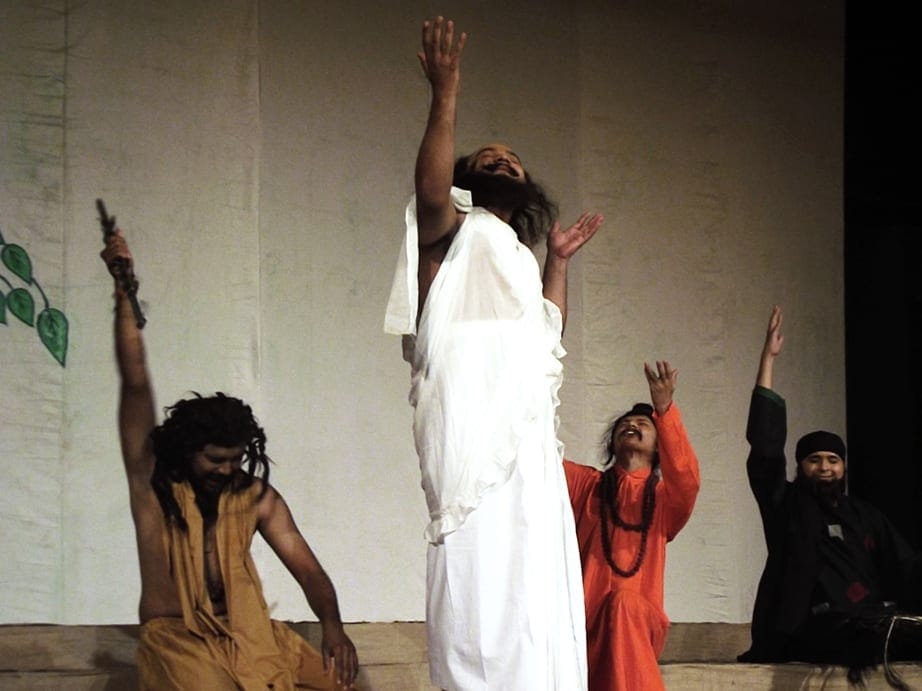
Apoorav Khela — meaning 'a wondrous play' — is the biography of Avdhoot Anandghanji, a 17th-century Jain mystical poet who dwelled in the forests of Rajasthan and whose name has been all but erased from the books of history. Anandghan — literally 'cloud of bliss' — was born as Labhanand, likely before 1624, and was initiated as a Svetambara monk in the Tapa Gaccha order under the name Labhavijaya. But monastic convention could not contain him. He became an avdhoot — an ascetic wanderer who had renounced all worldly attachments — and disappeared into the forests of Rajasthan, where his proximity to nature was said to pacify the beasts and make the trees sway in joy. His absence from monastic records suggests he was always an outsider, more mystic than monk. What survived is his poetry. Anandghan composed padas — devotional songs — in a mixed vernacular of Gujarati, Rajasthani, and Braj that were spontaneous, ecstatic, and radically non-sectarian. His Anandghan Chauvisi honours the twenty-four Jain Tirthankaras. His Anandghan Bahattari was transmitted orally and in manuscripts, its verses sometimes found alongside those of Kabir, Surdas, and Banarasidas. Mahatma Gandhi included one of his hymns in his prayer collection. His songs are still sung in Jain temples across India — and even appear in Digambara hymn collections, despite his Svetambara origins. The play, written by Dr. Dhanvant Shah and directed by Manoj Shah, is constructed from the anecdotes and oral traditions surrounding this enigmatic figure. Five actors — Ashok Parmar, Jay Upadhyay, Nimesh Dave, Manish Rohit, and Sagar Rawal — bring to life a man about whom barely any documented information exists. Kabir Thakore's set design and Uday Mazumdar's music carry the Rajasthani folk texture, while Rajesh Mandloi's language work ensures the dialect rings true. The play does not attempt a conventional narrative. It is, as its own programme notes describe it, 'an astonishing flight of happiness, beginning with anand and ending with Anandghan.'
Gathariya
Kaleidoscope
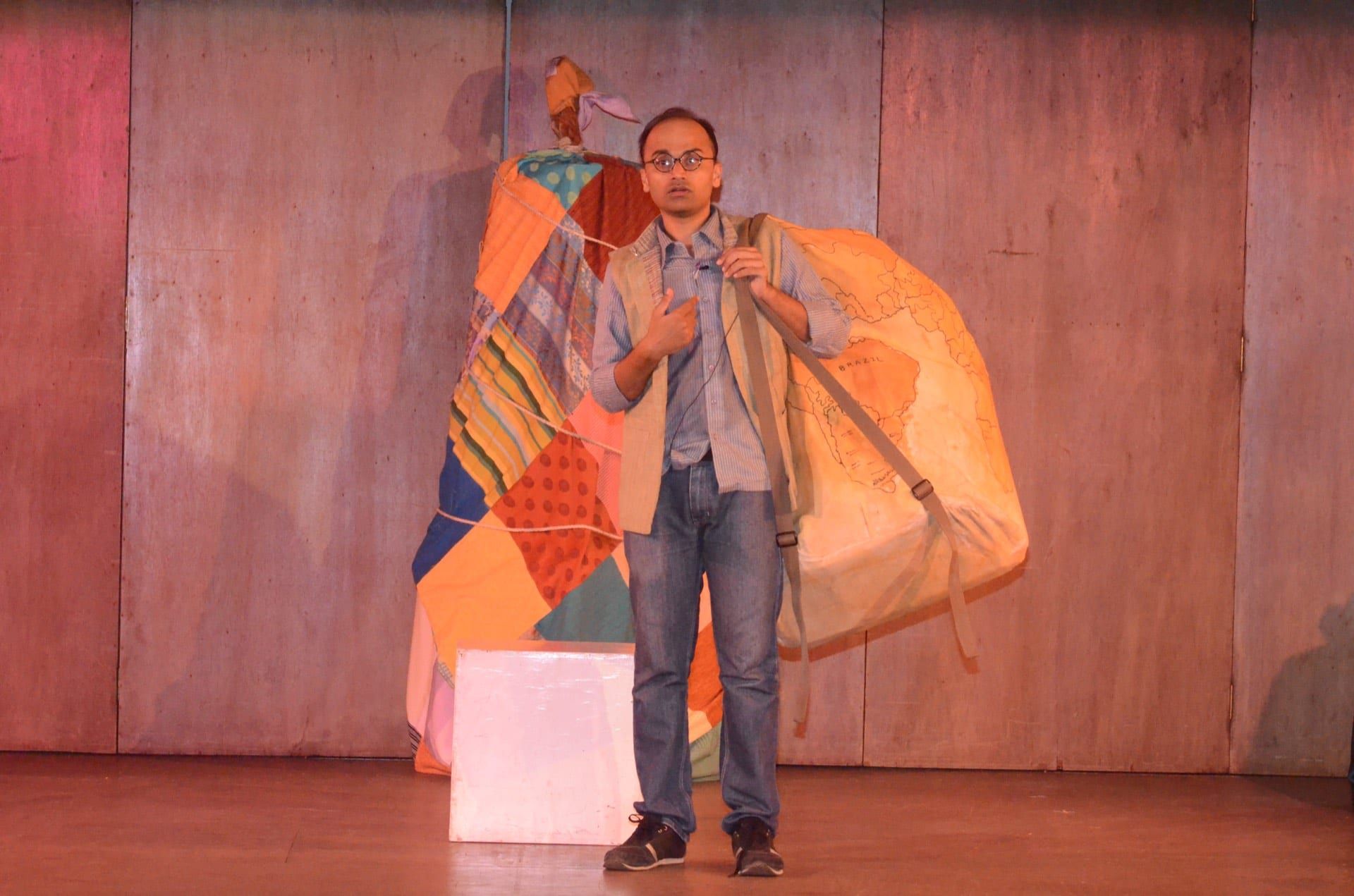
Chandravadan Chimanlal Mehta — Chan. Chi. Mehta to everyone who read him — spent his life packing and unpacking. He was born in Surat in 1901, schooled in Vadodara and Surat, wrote more than twenty-five plays including Agagadi, joined Gandhi at the Bardoli Satyagraha in 1928, taught at New Era High School in Bombay, went into All India Radio in 1938 and ran its Ahmedabad station, started the first diploma and degree courses in theatre in India at M. S. University in Baroda, and travelled — Europe, America, theatre after theatre — until the travelling became the writing. The twelve volumes he made of it are all called Gathariyan: bundles, the cloth-tied bedroll a traveller slings over one shoulder. Bandh Gathariyan. Chhod Gathariyan. Safar Gathariyan. Natya Gathariyan, the one on theatre, took the Sahitya Akademi Award in 1971. Manoj Shah's play takes the title and the image literally. Pulkit Solanki plays Mehta alone on a bare stage with two bundles: one stitched out of patchwork the height of a man, one painted as a map of the world. He unties them and the life comes out of them in no particular order — a doll made for a child, a name given, the first day of school and the first punishment in it, a marriage he did not want, a train to Surat, Uttarayan kites over the roofs, Bardoli, a film projector, the Ila poems that move without warning between nursery rhyme and elegy, Vande Mataram, Bach's St Matthew Passion, New York jazz, and the long way home. Kanti Patel wrote it; Satya Mehta made the dramatisation; Kanhaiya's fifty-two-cue score carries the century the way the bundles carry the luggage. The play is subtitled Kaleidoscope, and it earns the word. There is no chronology to hold on to and no second actor to play against — only a man, his luggage, and Shekhar Phadke's light finding him in it. What holds is the voice: the appetite of a man who wanted to see every stage on earth and then tell Gujarat about it in Gujarati. It premiered at the Godrej Dance Theatre at the NCPA, Mumbai, at four in the afternoon on 27 March 2016 — World Theatre Day, the observance Mehta's own record says he moved the resolution for at the International Theatre Institute's congress in Vienna, under UNESCO. It later played Prithvi Theatre, Juhu.
Pai Pai
A Play for Ages 6 to 106
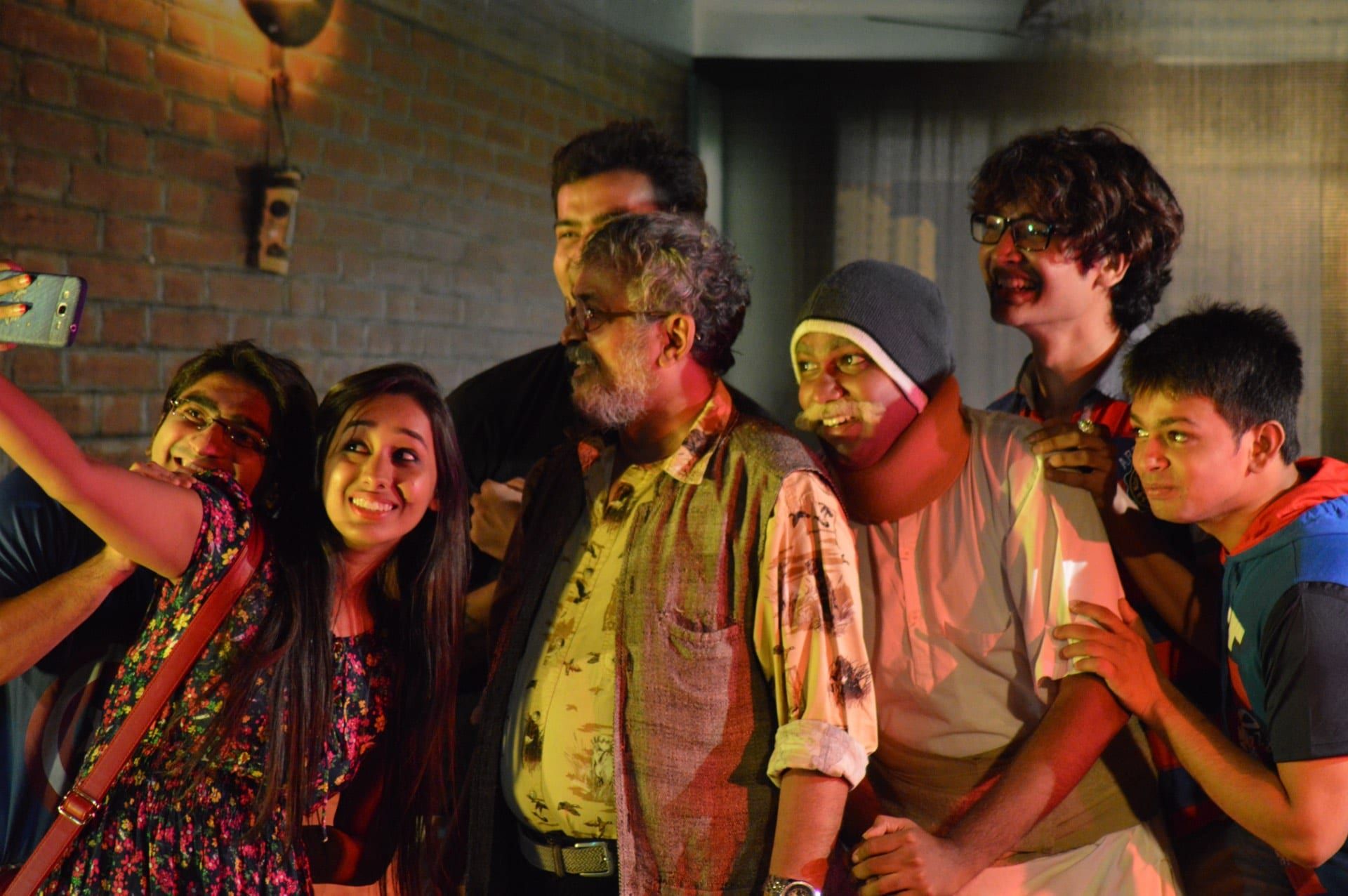
A pai was the smallest coin India ever minted — so small that the phrase pai pai came to mean every last fraction of what you own. Dhiruben Patel's play hangs one from a fishing line and lets a houseful of teenagers try to catch it. They are convinced their parents don't give them enough money. So they set out to earn some themselves, by every innovative scheme a group of school friends can dream up, and one after another the schemes fail. What arrives at the end is not a windfall but an understanding: of what it actually took their parents to build the comfortable home they had been taking for granted, and of how much of it was never about money at all. The play looks straight at the craze for money in the world these children are growing into, and does it as farce — a joke at the expense of everyone in the room, adults included. Written by Dhiruben Patel — novelist, playwright, editor of Sudha, president of the Gujarati Sahitya Parishad, and winner of the Ranjitram Suvarna Chandrak and the Sahitya Akademi Award — and directed by Manoj Shah, who also plays in it. Riddhi Vora, Durgesh Rajput, Maulik Shah, Prakash Waghela, Prashant Savalia, Nimesh Shinde and Rushikesh Chandaran complete the company, on a set that is a teenager's living room down to the pop-star posters on the wall. The poster puts the argument in one image: a 1945 one-pice coin with a hole through the middle, dangling on a line cast from a moon shaped like a pie. Two hours with an interval, and, as the Gujarati poster says, for children aged six to a hundred and six.
Bhav Prapanch
The Soul's Journey Through Worldly Illusion
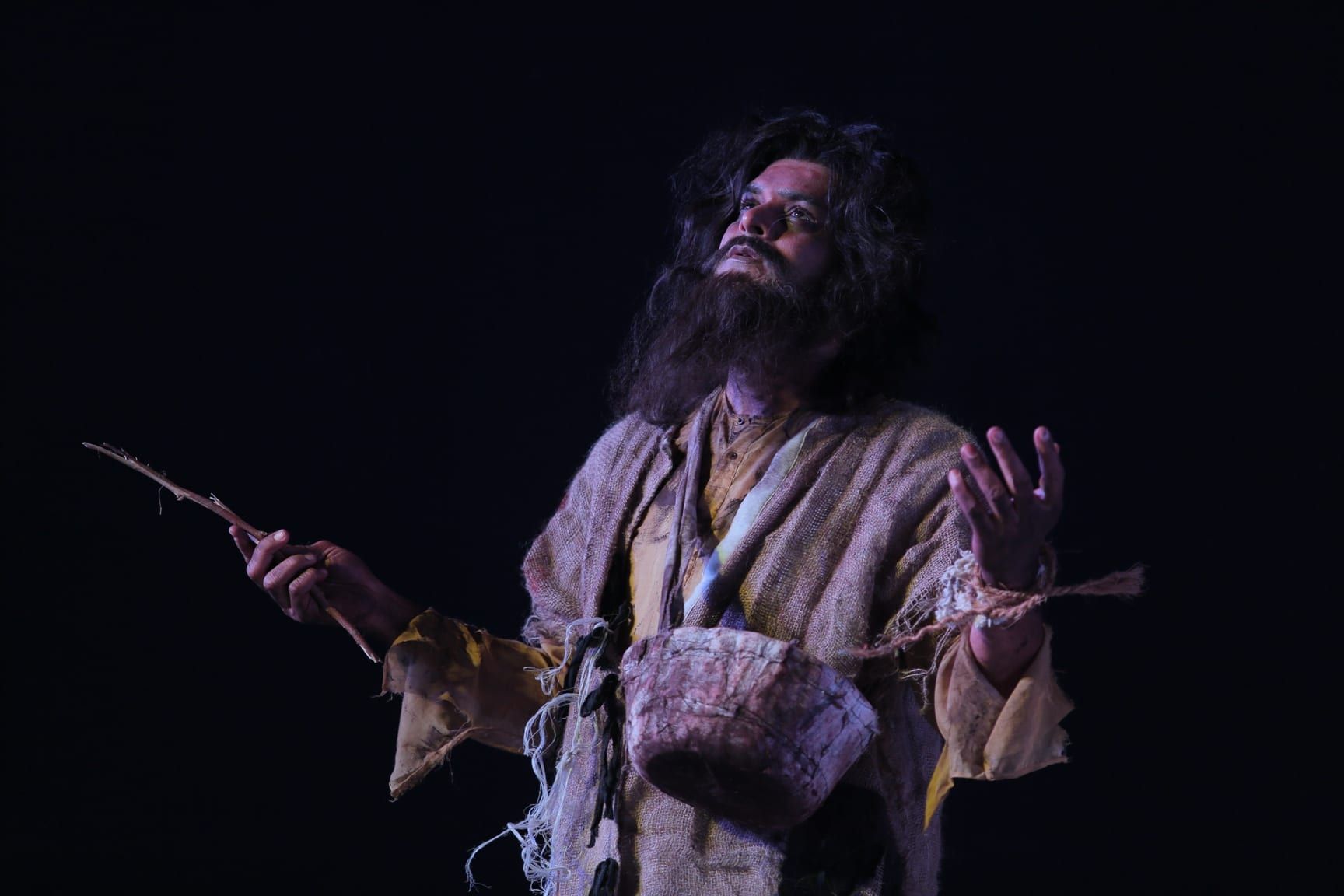
Based on the Upamitibhavaprapancha Katha by Siddharshi Gani — a 10th-century Sanskrit text that Hermann Jacobi called the first allegorical novel in Indian literature, predating Bunyan's Pilgrim's Progress by seven centuries. The play follows Dramak, an ordinary soul trapped in the city of Adrishyamool Paryant — a place that stands for the world as we know it, governed by greed, attachment, illusion, and desire. Dramak lives a bestial existence, wasting his time in futile efforts to preserve his meagre possessions. Caught in the bonds of attachment and illusion, believing the worldly illusion around him to be truth, he accumulates infinite karma and moves further from liberation with each birth and death. But there exists a Maharaja's royal temple — maintained with skill and devotion by servants who guide souls toward spiritual liberation through dharma, renunciation, compassion, and mercy. Their hands are always extended. The question is whether Dramak will take hold. The concept was distilled from Siddharshi's 16,000-verse original by Dr. Jitendra B. Shah, Director of the L.D. Institute of Indology, and dramatised by Prathang Dave and Raju Dave. Kabir Thakore designed the sets and Kanhaiya composed the music. The tagline reads: the end of sorrow is the beginning of peaceful happiness.
Master Builder
In All the Universe, I Alone Am God
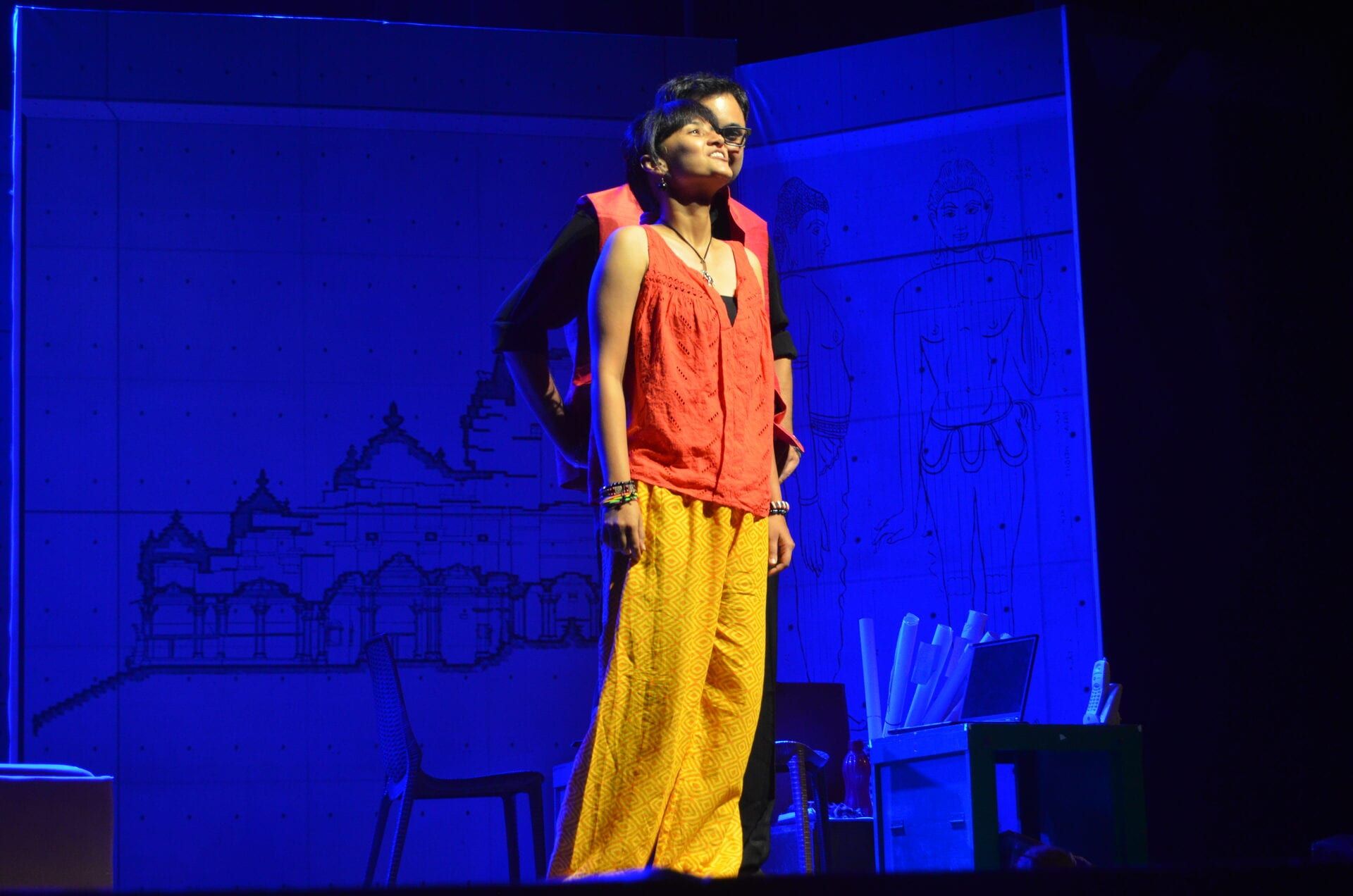
Henrik Ibsen published Bygmester Solness in December 1892, and for the next hundred and twenty-two years nobody staged it in Gujarati. When Ila Arun and K K Raina's Surnai Theatre invited Ideas Unlimited to make work for the first Ibsen Theatre Festival in Mumbai, Manoj Shah went through the whole canon looking for the play nobody had claimed. Every other major Ibsen — A Doll's House, Ghosts, Hedda Gabler, Peer Gynt — had already been translated into Gujarati, several of them performed. The Master Builder had not been translated, adapted or staged even once. "It is my choice and my decision," he wrote in his director's note, "to check myself as an artist." Chirantana Bhatt's adaptation moves the play from Norway to Mumbai, and Halvard Solness becomes Akhil Nanavati — an architect who prefers to be called a master builder, and who has made his name building temples. Ibsen's Christian imagery, gothic spires and mythic creatures give way to something older: the Sompura lineage of hereditary temple architects, the shikhara, three thousand years of building towards the sky. Knut Brovik, the old draughtsman Solness has broken, becomes Bhanushankar Sompura; his son Ragnar becomes Aadarsh; Hilde Wangel, who arrives out of nowhere to collect on a promise, becomes Kamya. Shah compressed Ibsen's three acts into two. Akhil is at the top and terrified of it. He is vain, unjust to the very people he learnt from, and frightened of the generation coming up behind him. His marriage to Saumya is a ruin held together by a fire years ago that took their children. Then Kamya walks in — twenty-four, from another town — and reminds him that they are not strangers, that he once made her a promise she chose to believe. She takes a place in his house, then in his practice, then in his head. She also discovers that the man who builds towers cannot bear heights. At the public opening of his newest building she asks him to climb it anyway. He does. He falls. Of the crowd standing appalled around the body, only Kamya steps forward, and she is smiling: my master builder. The poster carried the whole argument in a single line. Narsinh Mehta's fifteenth-century bhajan opens Akhil brahmandma ek tu Shrihari — in all the universe, you alone are God. Ideas Unlimited changed one word. Ek hu ja Shrihari: I alone am God. The architect's name is Akhil. Master Builder was made for the inaugural Ibsen Theatre Festival in Mumbai, ran at Bhaidas Auditorium on 9 November 2014, and had its first independent show at Prithvi Theatre on 14 December 2014.
Karl Marx In Kalbadevi
Revolution via Entertainment
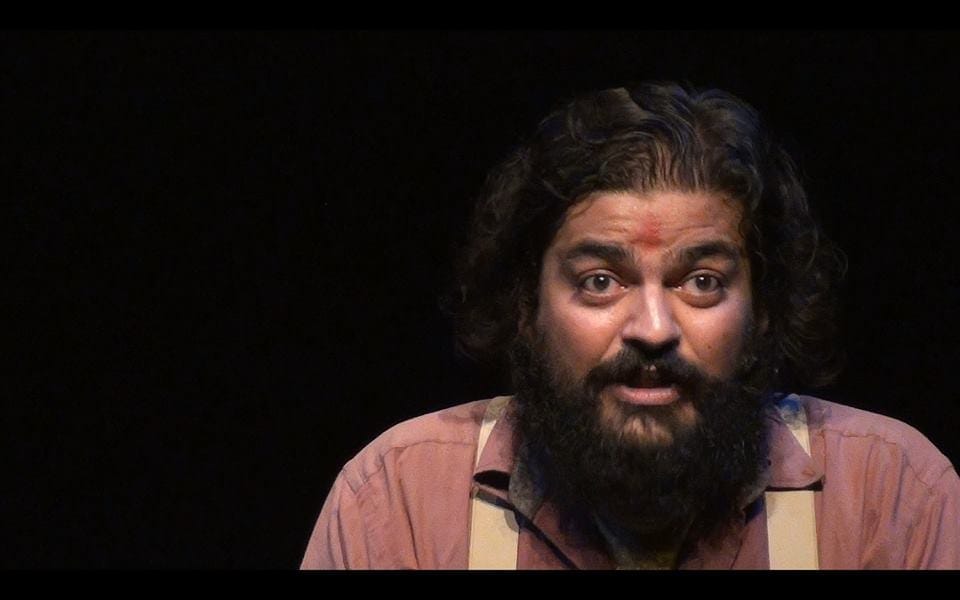
What happens when Karl Marx returns from the dead and lands straight into the buzzing chaos of Kalbadevi, Mumbai’s most unapologetically capitalist neighbourhood? He is furious. Not just about capitalism running wild or billionaires launching rockets — but because people have twisted his words, misused his ideas, and turned ‘Marxist’ into a punchline. He wants to set the record straight. But Mumbai is not in the mood for lectures. So he adapts. He rants, he jokes, he dances Gangnam Style, he reviews a Gujarati thali at Bhagat Tarachand, he learns Gujarati because of his admiration for Mahatma Gandhi, and he tries to visit Mani Bhavan only to find the gates shut. Written by Uttam Gada and directed by Manoj Shah, this one-man play has been Ideas Unlimited’s calling card for over twelve years. Satchit Puranik — who looks the part with his wild hair, beard, and a tilak on his forehead — brings a manic energy to Marx that makes the philosopher feel less like a historical figure and more like your most opinionated uncle at a family wedding. The play premiered at the NCPA Vasant Gujarati Natya Utsav in 2013, has since been performed in Gujarati, Hindi, and Hinglish, and staged at Wilson College for the 150th anniversary of Das Kapital, at Aligarh Muslim University, and at JAINA conventions in the United States. As Time Out Mumbai’s Deepa Gahlot put it: the play is ‘enough to provoke the audience to go back thinking, this Karlbhai was one clever dude, eh?’