Bhamasha
The Warrior Who Funded Freedom
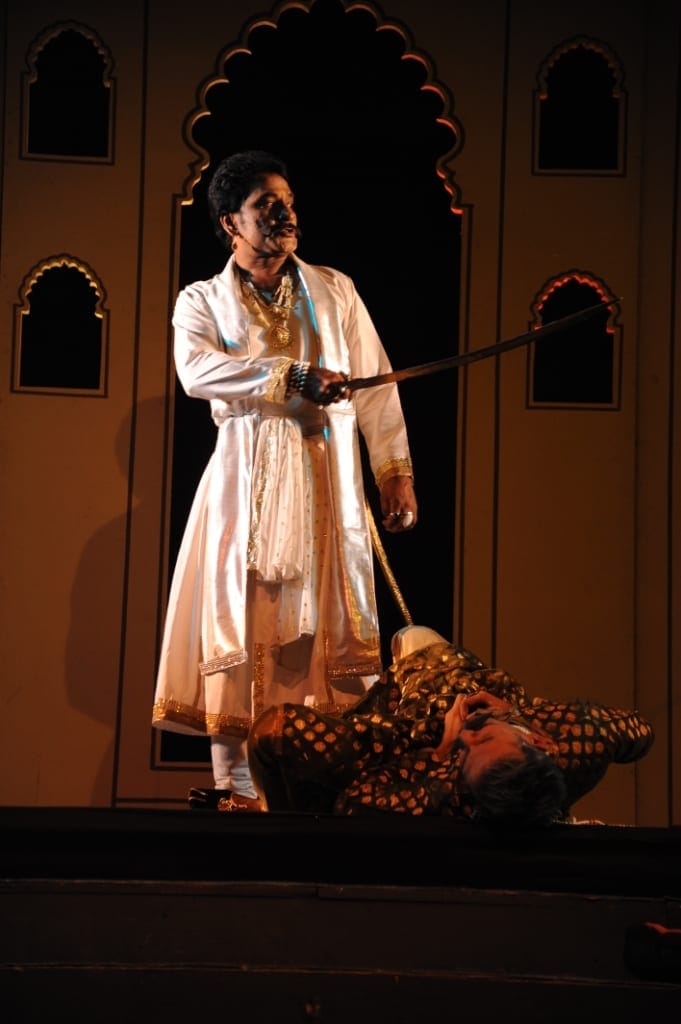
The story of Bhamashah — born 1547, Jain Shravak of the Oswal community, warrior, strategist, and the man who bankrolled Maharana Pratap's war against the Mughal empire. Little is known about him beyond the legend of his donation, but this play recovers the full arc of his life: his father Bharmal's service as fort commander of Ranthambore, his own rise as Diwan of Mewar, his raids on Mughal camps, and the moment at the village of Chulia when he presented twenty lakh gold coins and two-and-a-half crore silver rupees to a king with no kingdom left. Ideas Unlimited — known for dramatising biographies in Gujarati — chose to tell this story in Hindi, bringing it to the Tata Theatre at NCPA on Republic Day 2013. The story was conceived by Dr. Bipin Doshi and dramatised by Mihir Bhuta. Dayashankar Pandey, who had appeared in Lagaan and Swades, took on the title role, working on the Rajasthani dialect to inhabit a man who proved that ahimsa does not mean cowardice. Om Puri lent his voice as narrator. Chugge Khan and his ensemble of Manganiar folk musicians from Rajasthan performed the Marwari folk score live, transporting the audience four centuries into the past. Bhamasha is a play about a question most histories ignore: who pays for freedom? Not the king on the battlefield, but the man behind him — the merchant, the strategist, the Jain who believed that protecting his land was as sacred as any vow of non-violence.
The People
Behind
the Play
Press &
Reviews
Hindustan Times
Blast From The Past: New Hindi Play Revolves Around Bhamasha
Whether Shah Jahan, Ashoka, or Bhamasha — Indian history is full of intriguing tales. Veteran actor Dayashankar Pandey brings the 16th-century Jain warrior to life, with folk musician Chugge Khan and his Rajasthani ensemble providing the score.
25 January 2013
Mid-Day
History Comes Alive On Stage
This Republic Day, catch a Hindi play that joys tribute to Bhamasha, advisor to Maharana Pratap who donated all his wealth to Mewar to aid the war against the Mughals.
26 January 2013
Also Worth
Seeing
Popcorn with Parsai
Harishankar Parsai Alive
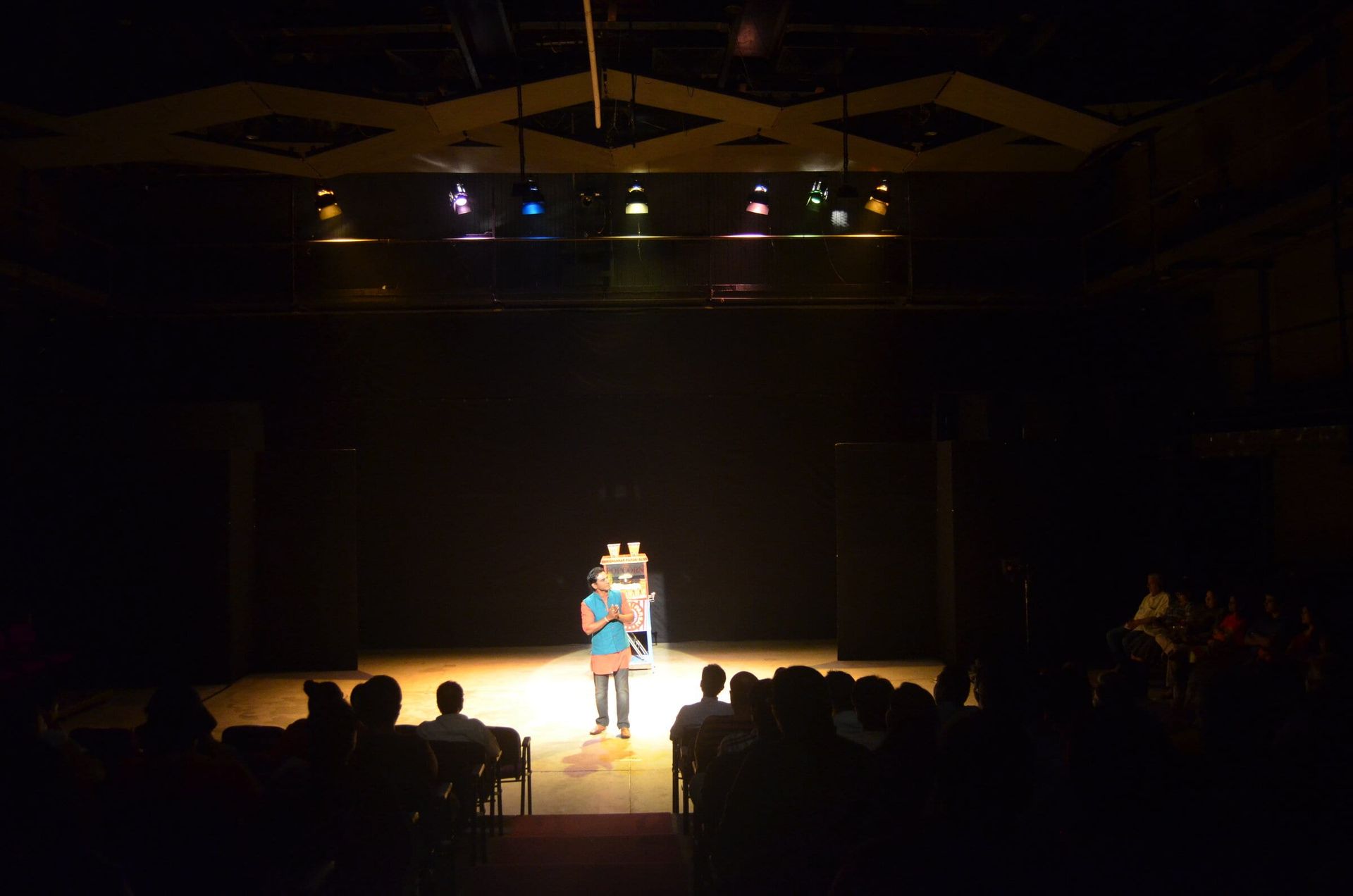
A popcorn cart is wheeled onto an empty stage. It is the kind you see outside a cinema — striped red and white, glass box, bicycle wheels, paper cones stacked on the roof — except that the hoarding across its top does not advertise popcorn. It reads HARISHANKAR PARSAI ALIVE. One man comes out, and for the next hour he sells you the collected works of modern Hindi's fiercest satirist the way a vendor sells snacks at the interval: a fistful at a time, salted, cheap, and impossible to stop eating. Harishankar Parsai (1924–1995) is the writer who made vyangya — satire — a form Hindi literature had to take seriously. He was born at Jamani near Itarsi in Madhya Pradesh, took an MA in Hindi at Nagpur, and then spent his whole working life in Jabalpur, where he founded the literary magazine Vasudha, watched it close for want of money, and answered readers' questions in Deshbandhu under the standing headline Poochhiye Parsai Se — Ask Parsai. He wrote in a plain, flat, unliterary Hindi that gave him room to be merciless. A dead clerk's soul gets stuck in government red tape in Bholaram ka Jeev. A policeman is sent to the moon to teach the lunar force Indian methods in Inspector Matadeen Chand Par. Premchand ke Phate Joote takes a photograph of India's greatest novelist in torn shoes and turns it into an argument about what the country does to its writers. Viklaang Shraddha ka Daur won him the Sahitya Akademi Award in 1982. He was a man of the Left who spared the Left nothing, and two generations of Indian schoolchildren have met him in their NCERT textbooks without ever quite realising what they were reading. Nilay Upadhyay's script does not narrate that biography. It puts the writing in the vendor's mouth and lets the man assemble himself out of his own sentences — funny enough to make you laugh, as the production's own line had it, serious enough to prick your conscience. Manoj Shah directed it as a fantasy on a bare floor: a cart, a folding chair, a light, and Dayashankar Pandey. Pandey — Goli in Lagaan, Inspector Chalu Pandey in Taarak Mehta Ka Ooltah Chashmah — is on stage from the first second to the last with nobody to play against, and the whole architecture of the evening rests on how fast he can change register: vendor, clerk, policeman, poet, the dead man arguing with a file. He has called it a dream role for any actor. It opened at the NCPA in Mumbai on 6 December 2014 and went on to run forty-eight shows, all of them housefull, travelling with a company of six — Surat's Science Centre in November 2015, Prithvi Theatre on 10 February 2016, and on from there. The poster carried a green vegetarian mark and the line “recommended for age 9+”, which is a joke, and also true.
Virayan
Gatha Prabhu Veer Ni
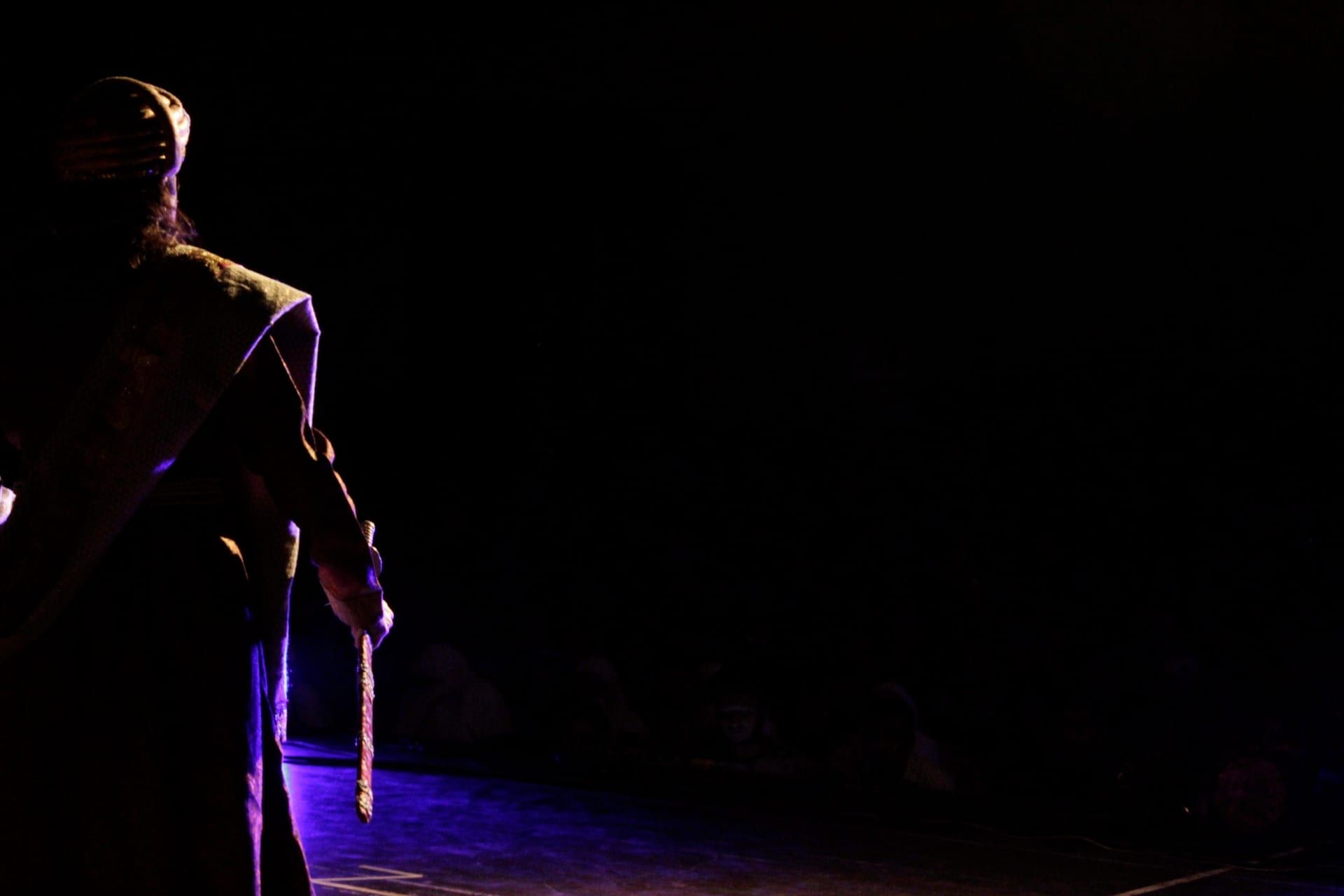
Magadha, in the lifetime of Mahavir. King Shrenik has just read a letter from his dying nagarsheth — a man who spent a whole life enlarging a trade across countries and never found an hour for his wife, his sons or his God, and who writes at the end to say so. Shrenik puts the letter down and sends for his minister. Samay ja samay nu kaam kare, he says: time does time's own work. Before his subjects sleep their way to the same regret, he wants to walk out among them. What the king finds on that walk is the first half of the play. A young man pays a vegetable seller five gold mohar for a mohar's worth of brinjals, because three and a half dokda were left owing in that lane by his father years earlier and he had promised to clear them. Two merchants who have competed all their lives sit together, and the one with money offers to pay for the other's daughter's wedding. A farmer sends the year's surplus grain to the royal granary because three people do not need it. Nobody sermonises. This is simply what people do under a king who is trying to live well, and it is the ground the rest of the play stands on. Then the figures Jain literature has carried for twenty-five centuries come on, and Shrenik stays as sutradhar — the audience's way in. Mahavir's household is here: his brother Nandivardhan, his wife Yashoda and his daughter Priyadarshana, the people a renunciation is walked away from and who then have to go on living. So are his disciples — Sudharmaswami; Indrabhuti Gautam, the Vedic scholar who arrives to defeat him in debate and leaves as his first ganadhar; and Goshalak, the follower who breaks away, turns on his teacher and hurls the tejoleshya at him. At the end Shrenik himself is in a cell, imprisoned by his own son Kunik, calling on the master he had spent the play introducing. Written by Satya Mehta and directed by Manoj Shah, Virayan sets all of it on the plainest Jain proposition there is: karma. Not doctrine handed down from a dais, but the thing that quietly settles what becomes of each of these people. Kanhaiya wrote a fifty-four-cue score, sung by Parthiv Gohil, Suresh Joshi and Uday Mazumdar, and Huseini Dawawala lit the two acts and assisted the direction. It was presented by Ajaramar Youths and played at the Zaverben Sabhagruh in Hingwala, Ghatkopar, on the morning of 6 October 2018, to a hall that held the monks and nuns of the Shri Vardhman Sthanakvasi Jain Shravak Sangh along with its lay members.
Mohan No Masalo
Recipe for Making a Mahatma
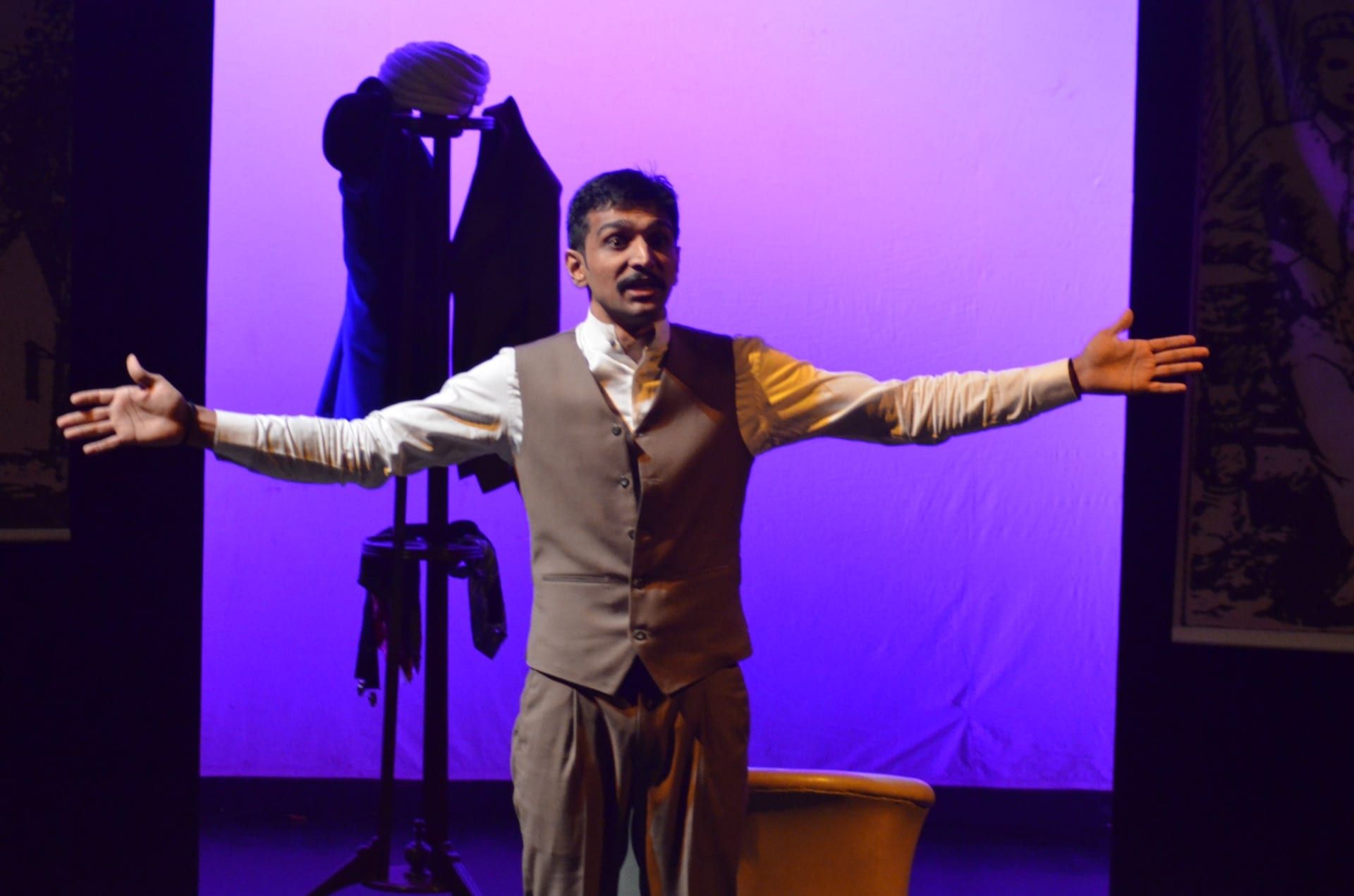
The play that entered the Limca Book of Records. The play that Pratik Gandhi performed before Scam 1992 made him famous. The play about Mohandas Gandhi before he became the Mahatma. Mohan No Masalo — Mohan’s Spices — recovers the young Mohandas: the scared boy from Porbandar, the awkward teenager who married at thirteen, the mediocre student who sailed to London to study law, the diffident barrister who failed in Bombay courts, and the accidental activist who boarded a train in South Africa and found his purpose when he was thrown off it. These are the masalas — the spices — that made the Mahatma. The recipe, told by the man himself. Pratik Gandhi performs the ninety-minute monologue alone against Atul Dodiya’s black-and-white backdrop paintings of a young Gandhi. The Gujarati script was written by Satya Mehta, the Hindi version by Mihir Bhuta and Arpit Jain, the English by Ishan Doshi. Parthiv Gohil provided the vocal performances. The play premiered on 22 March 2015 at NCPA and was subsequently performed in all three languages — Gujarati (Mohan No Masalo), Hindi (Mohan Ka Masala), and English (Mohan’s Masala) — in a single day at the same theatre by the same actor. This feat earned a Limca Book of Records entry for ‘Performance of One Play in Multiple Languages in One Day.’ Manoj Shah on why he made this play: ‘I wanted to be with youth. Best way to re-invent ideas for youth without cliché results is Mohan ka Masala.’
Pai Pai
A Play for Ages 6 to 106
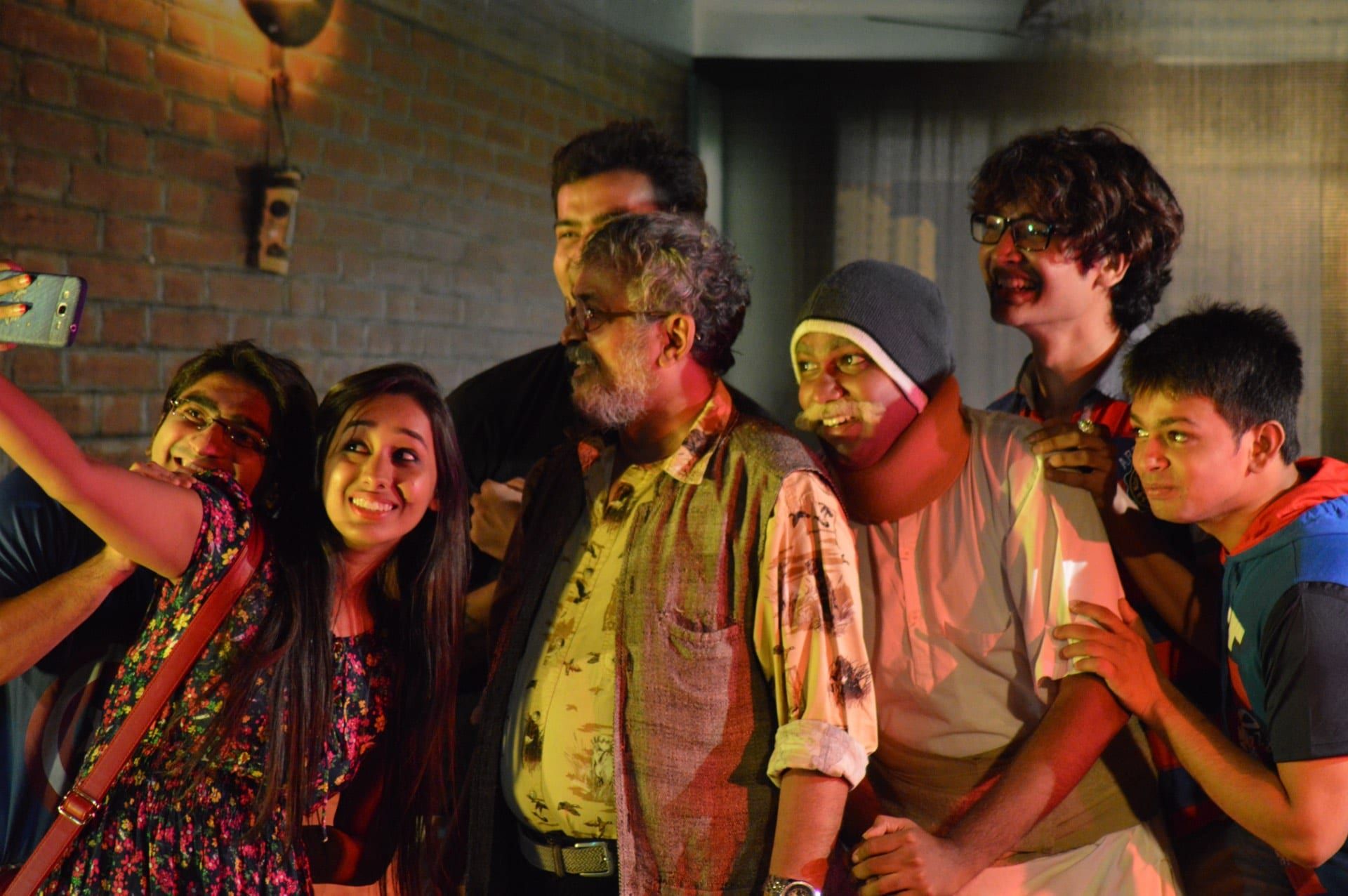
A pai was the smallest coin India ever minted — so small that the phrase pai pai came to mean every last fraction of what you own. Dhiruben Patel's play hangs one from a fishing line and lets a houseful of teenagers try to catch it. They are convinced their parents don't give them enough money. So they set out to earn some themselves, by every innovative scheme a group of school friends can dream up, and one after another the schemes fail. What arrives at the end is not a windfall but an understanding: of what it actually took their parents to build the comfortable home they had been taking for granted, and of how much of it was never about money at all. The play looks straight at the craze for money in the world these children are growing into, and does it as farce — a joke at the expense of everyone in the room, adults included. Written by Dhiruben Patel — novelist, playwright, editor of Sudha, president of the Gujarati Sahitya Parishad, and winner of the Ranjitram Suvarna Chandrak and the Sahitya Akademi Award — and directed by Manoj Shah, who also plays in it. Riddhi Vora, Durgesh Rajput, Maulik Shah, Prakash Waghela, Prashant Savalia, Nimesh Shinde and Rushikesh Chandaran complete the company, on a set that is a teenager's living room down to the pop-star posters on the wall. The poster puts the argument in one image: a 1945 one-pice coin with a hole through the middle, dangling on a line cast from a moon shaped like a pie. Two hours with an interval, and, as the Gujarati poster says, for children aged six to a hundred and six.
Bhav Prapanch
The Soul's Journey Through Worldly Illusion
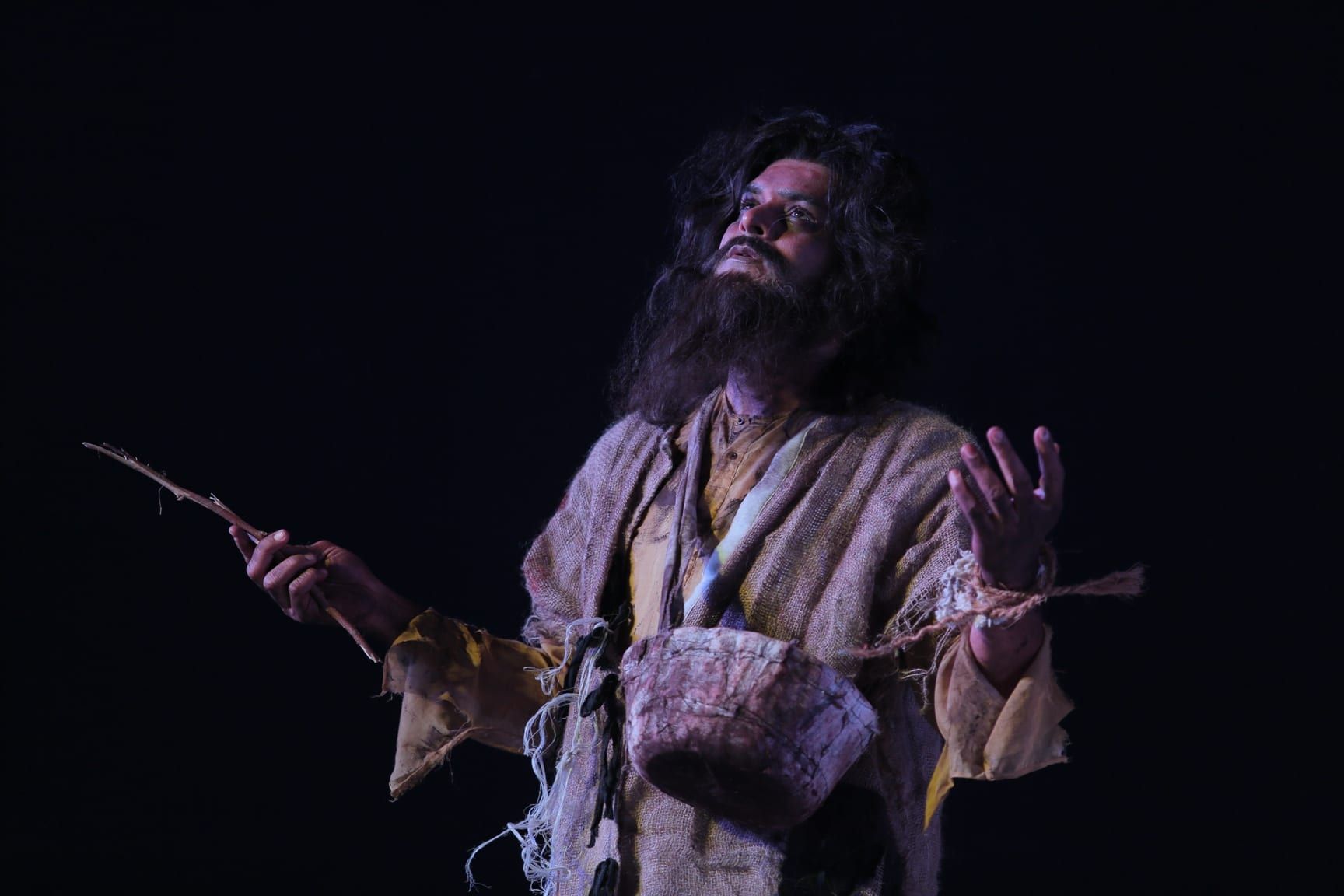
Based on the Upamitibhavaprapancha Katha by Siddharshi Gani — a 10th-century Sanskrit text that Hermann Jacobi called the first allegorical novel in Indian literature, predating Bunyan's Pilgrim's Progress by seven centuries. The play follows Dramak, an ordinary soul trapped in the city of Adrishyamool Paryant — a place that stands for the world as we know it, governed by greed, attachment, illusion, and desire. Dramak lives a bestial existence, wasting his time in futile efforts to preserve his meagre possessions. Caught in the bonds of attachment and illusion, believing the worldly illusion around him to be truth, he accumulates infinite karma and moves further from liberation with each birth and death. But there exists a Maharaja's royal temple — maintained with skill and devotion by servants who guide souls toward spiritual liberation through dharma, renunciation, compassion, and mercy. Their hands are always extended. The question is whether Dramak will take hold. The concept was distilled from Siddharshi's 16,000-verse original by Dr. Jitendra B. Shah, Director of the L.D. Institute of Indology, and dramatised by Prathang Dave and Raju Dave. Kabir Thakore designed the sets and Kanhaiya composed the music. The tagline reads: the end of sorrow is the beginning of peaceful happiness.
Master Builder
In All the Universe, I Alone Am God
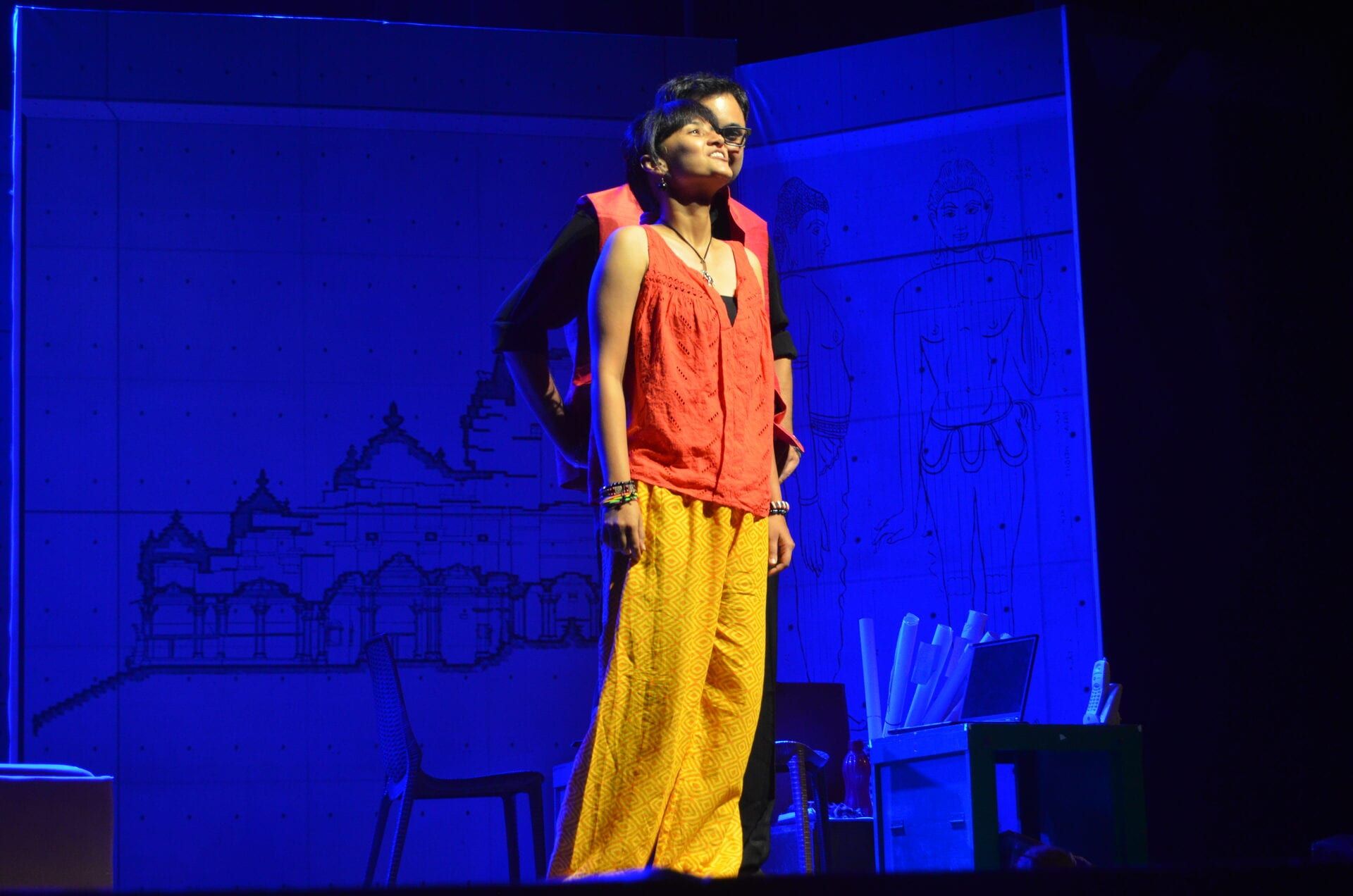
Henrik Ibsen published Bygmester Solness in December 1892, and for the next hundred and twenty-two years nobody staged it in Gujarati. When Ila Arun and K K Raina's Surnai Theatre invited Ideas Unlimited to make work for the first Ibsen Theatre Festival in Mumbai, Manoj Shah went through the whole canon looking for the play nobody had claimed. Every other major Ibsen — A Doll's House, Ghosts, Hedda Gabler, Peer Gynt — had already been translated into Gujarati, several of them performed. The Master Builder had not been translated, adapted or staged even once. "It is my choice and my decision," he wrote in his director's note, "to check myself as an artist." Chirantana Bhatt's adaptation moves the play from Norway to Mumbai, and Halvard Solness becomes Akhil Nanavati — an architect who prefers to be called a master builder, and who has made his name building temples. Ibsen's Christian imagery, gothic spires and mythic creatures give way to something older: the Sompura lineage of hereditary temple architects, the shikhara, three thousand years of building towards the sky. Knut Brovik, the old draughtsman Solness has broken, becomes Bhanushankar Sompura; his son Ragnar becomes Aadarsh; Hilde Wangel, who arrives out of nowhere to collect on a promise, becomes Kamya. Shah compressed Ibsen's three acts into two. Akhil is at the top and terrified of it. He is vain, unjust to the very people he learnt from, and frightened of the generation coming up behind him. His marriage to Saumya is a ruin held together by a fire years ago that took their children. Then Kamya walks in — twenty-four, from another town — and reminds him that they are not strangers, that he once made her a promise she chose to believe. She takes a place in his house, then in his practice, then in his head. She also discovers that the man who builds towers cannot bear heights. At the public opening of his newest building she asks him to climb it anyway. He does. He falls. Of the crowd standing appalled around the body, only Kamya steps forward, and she is smiling: my master builder. The poster carried the whole argument in a single line. Narsinh Mehta's fifteenth-century bhajan opens Akhil brahmandma ek tu Shrihari — in all the universe, you alone are God. Ideas Unlimited changed one word. Ek hu ja Shrihari: I alone am God. The architect's name is Akhil. Master Builder was made for the inaugural Ibsen Theatre Festival in Mumbai, ran at Bhaidas Auditorium on 9 November 2014, and had its first independent show at Prithvi Theatre on 14 December 2014.