
Master Phoolmani
Once More, Shout It Loud

Bhangwadi Theatre stood on the corner of Princess Street in Kalbadevi from 1874 until it closed in 1968. Its plays ran all night, carried forty songs apiece, and had no microphones — everything depended on lungpower. When the audience shouted "once more" the actor sang the song again with a new verse, sometimes twenty times over, while coins and cash and garlands rained onto the stage; the more popular companies strung nets to protect their performers from the money. Special trains brought audiences from Kolkata, Chennai, Cochin, Vadodara and Surat. Outside, the whole of Kalbadevi was lit with lamps, and before curtain-up a gun loaded with potash powder was fired into the air and the doors opened. Master Phoolmani is a play about two men who have nowhere left to put that world. Chandrakant Shah's script takes Satish Alekar's Marathi masterpiece Begum Barve as its structure and spikes it with the life of Jayashankar Sundari — who, with Bal Gandharva, was the legendary actor-singer of female roles in the early twentieth century, in an era when women were not allowed on stage at all, and who taught the young girls and the wives of rich seths how to wear a sari and carry themselves. Manilal is a Bhangwadi actor whose stage name was Master Phoolmani and whose theatre no longer exists. Sheth Vallabhdas Bhatia, once immensely rich, is still besotted with Phoolmani's music. Vasantlal and Sumanlal are bachelor government clerks with no marriage prospects and a great deal of imagination. Out of that meeting the four of them build a fantasy and move into it. Manilal becomes the heroine Vanlata and marries Sumanlal; both come to believe she is pregnant. Then Bhatia Seth and Vasantlal pull the fantasy down, and the ending is not funny at all. As Manoj Shah put it, the physical relationship between the lonely out-of-work Bhangwadi actors and the unemployed clerks was never the point — their need to connect was more important than sex. The staging kept the Bhangwadi rules and dropped its budget. Only men act in the play. The musicians are trained singers in the Bhangwadi and Bhavai styles, playing live on tabla, dholak and a folding beech-wood organ over seventy-five years old, imported from America by film actor Ashok Kumar's company and one of the few such instruments left in India — the same organ used by Master Krishnarao Fulambrikar in the Sangeet Natak. There are twenty-nine songs, built on particular ragas, old folk tunes and traditional melodies, and the actors sing them all. Bhupen Khakhar — India's first Pop artist, a Padma Shri, four years from the end of his life — painted the backdrop as eleven-foot portraits on collapsible folding frames, with a golden curtain to halve the stage. Jayashankar Sundari and Bal Gandharva wore elaborate women's costumes; this company did not have the money, so a dhoti is folded into a sari and the audience is left to complete it. Master Phoolmani opened at Horniman Circle Gardens on 15 November 1999 as part of the Prithvi Theatre Festival and ran until 2015 — over a hundred performances, the longest run in Ideas Unlimited's history. The poster promised what the play delivered: one more chance to shout once more.
The People
Behind
the Play
Press &
Reviews
The Times of India (Life & Style)
Critics' Choice: Kundan Shah on Master Phoolmani
I saw the Gujarati play Master Phulmani the other day, and found it so outstanding that I went back to watch it again the next day.
2 June 2002
Bombay Times (Deepa Gahlot)
Language No Bar
The other Mumbai play, Master Phoolmani, by Manoj Shah, which is the Gujarati adaptation of Satish Alekar's masterpiece Begum Barve, could stand proudly anywhere among the best in the country.
11 November 2003
Also Worth
Seeing

Master Madam
Neither Religion Nor Prostitution
Master Madam is Bhagavadajjukam — a Sanskrit farce roughly 1,600 years old, traditionally attributed to a playwright called Bodhayana about whom nothing else is known, and the oldest surviving comedy in the Indian repertoire. Manoj Shah staged it in Gujarati for the Prithvi Theatre Festival 2013, whose theme that year was world classics. The plot turns on a body swap, which makes this very likely the first body-swap comedy ever written — centuries ahead of Ovid, Shakespeare or Kafka. A sadhu has practised yoga to the point where he believes his soul can leave a body and enter another at will. A ganika — a courtesan — believes her body can get her anything she wants. Yamraj, working through the day's quota of souls to collect, makes a clerical error: he lifts the courtesan Vasantsena instead of her friend, and gets a dressing-down from Chitragupta for it. Meanwhile the sadhu's exasperating assistant Shandilya dares him to prove his powers by bringing the dead woman back, so the sadhu moves his own soul into her body. Yamraj returns to correct the mistake, finds Vasantsena's body already occupied, and drops her soul into the sadhu instead. Two people are now living in the wrong bodies, and neither can stop being who they were. Ideas Unlimited played it as a farce that keeps its philosophy. Yamraj argues in colloquial Hindi, Gujarati, Marathi and English; Shandilya is a devotee of one Swami Rajnikanteshwar and wants nothing to do with his master's discipline; a line of disciples in white shawls chants behind them. The stage is close to bare — Kabir Thakore's painted backdrop of a tree, Kanhaiya's score, and Shekhar Phadke's lighting dividing the floor into zones, with Akash Naik's choreography moving bodies through them. Reviewing it for MumbaiTheatreGuide, Pratik Kothari singled out the climax, where the two souls and two bodies move back towards equilibrium — the ascetic who is all control, the courtesan whose work is to satisfy desire — and called the presentation of that transformation deserving of applause. The poster put the play's proposition in one line: you can't call it religion, and you can't call it prostitution, so better call it Master Madam. It runs 120 minutes with an interval and carries an advisory of sixteen and above. In Kerala, where Bhagavadajjukam survived inside the Kutiyattam repertoire, the full ritual performance of the same story once took more than a month.
Master Builder
In All the Universe, I Alone Am God
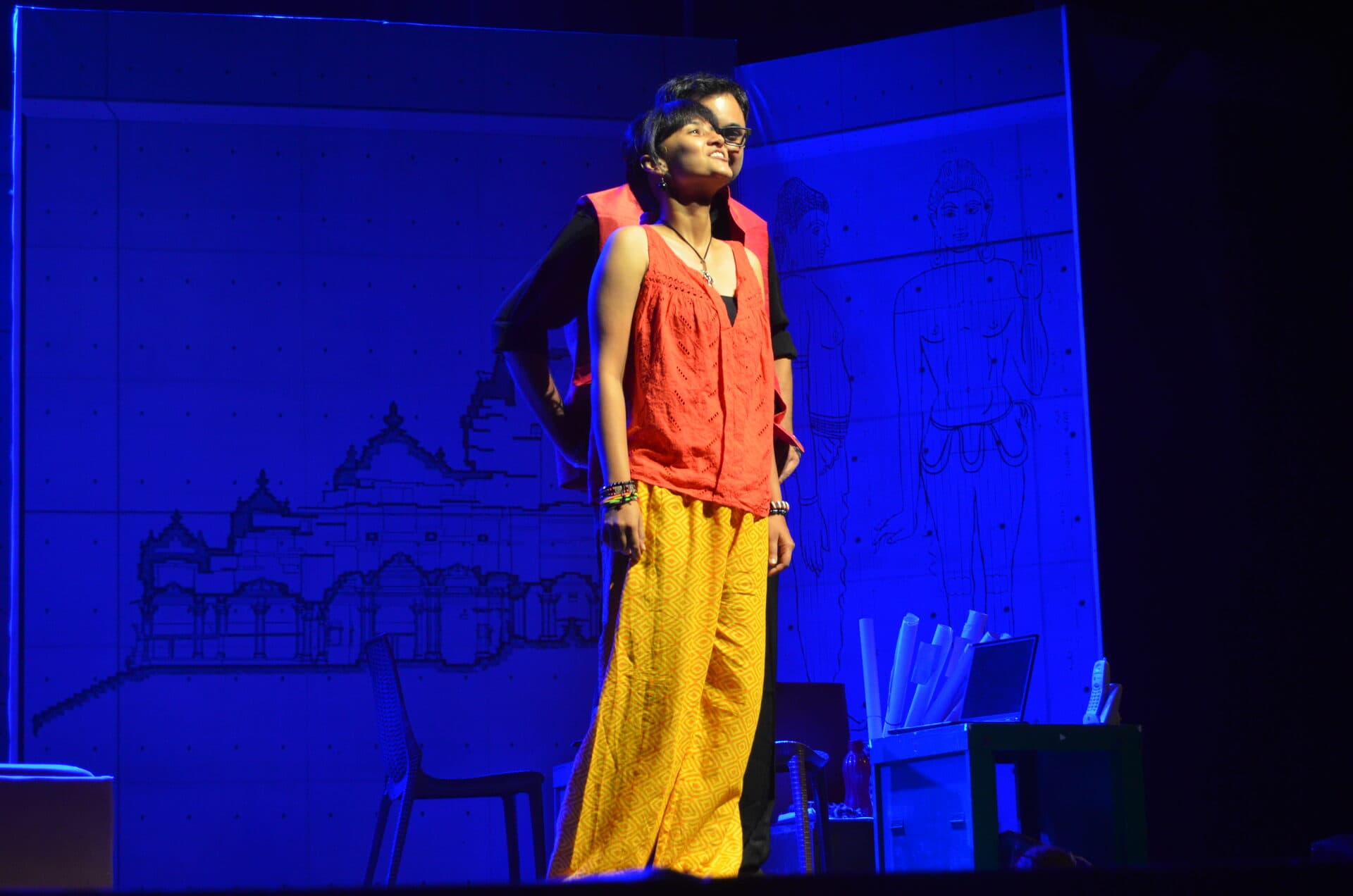
Henrik Ibsen published Bygmester Solness in December 1892, and for the next hundred and twenty-two years nobody staged it in Gujarati. When Ila Arun and K K Raina's Surnai Theatre invited Ideas Unlimited to make work for the first Ibsen Theatre Festival in Mumbai, Manoj Shah went through the whole canon looking for the play nobody had claimed. Every other major Ibsen — A Doll's House, Ghosts, Hedda Gabler, Peer Gynt — had already been translated into Gujarati, several of them performed. The Master Builder had not been translated, adapted or staged even once. "It is my choice and my decision," he wrote in his director's note, "to check myself as an artist." Chirantana Bhatt's adaptation moves the play from Norway to Mumbai, and Halvard Solness becomes Akhil Nanavati — an architect who prefers to be called a master builder, and who has made his name building temples. Ibsen's Christian imagery, gothic spires and mythic creatures give way to something older: the Sompura lineage of hereditary temple architects, the shikhara, three thousand years of building towards the sky. Knut Brovik, the old draughtsman Solness has broken, becomes Bhanushankar Sompura; his son Ragnar becomes Aadarsh; Hilde Wangel, who arrives out of nowhere to collect on a promise, becomes Kamya. Shah compressed Ibsen's three acts into two. Akhil is at the top and terrified of it. He is vain, unjust to the very people he learnt from, and frightened of the generation coming up behind him. His marriage to Saumya is a ruin held together by a fire years ago that took their children. Then Kamya walks in — twenty-four, from another town — and reminds him that they are not strangers, that he once made her a promise she chose to believe. She takes a place in his house, then in his practice, then in his head. She also discovers that the man who builds towers cannot bear heights. At the public opening of his newest building she asks him to climb it anyway. He does. He falls. Of the crowd standing appalled around the body, only Kamya steps forward, and she is smiling: my master builder. The poster carried the whole argument in a single line. Narsinh Mehta's fifteenth-century bhajan opens Akhil brahmandma ek tu Shrihari — in all the universe, you alone are God. Ideas Unlimited changed one word. Ek hu ja Shrihari: I alone am God. The architect's name is Akhil. Master Builder was made for the inaugural Ibsen Theatre Festival in Mumbai, ran at Bhaidas Auditorium on 9 November 2014, and had its first independent show at Prithvi Theatre on 14 December 2014.
Achalayatan
Rabindranath Tagore's Allegory of Freedom
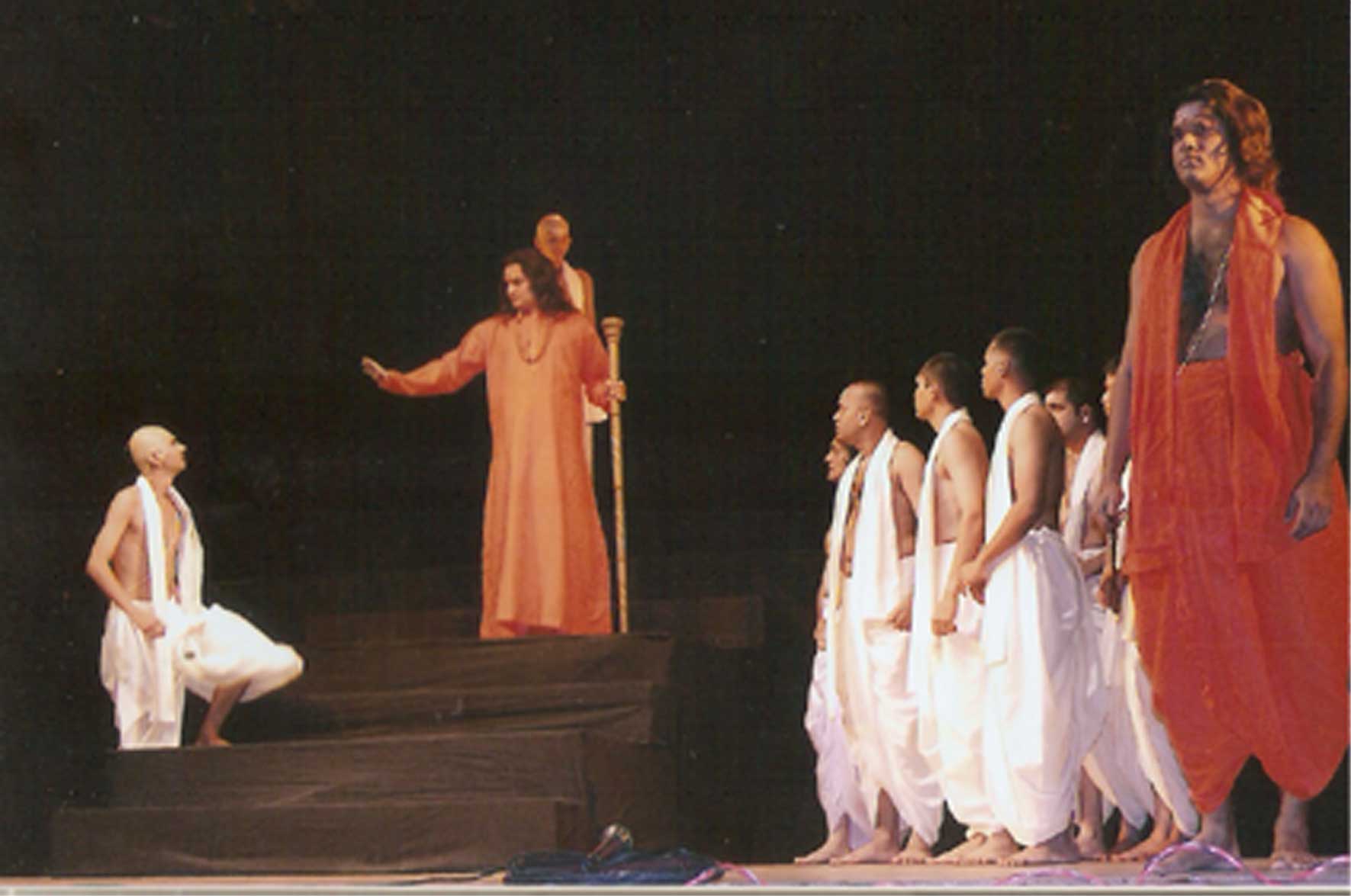
Tagore's searing allegory of an ashram so rigid that even light is forbidden entry. A young student named Panchak, unable to cope with the dead weight of rules, peeks through a forbidden window and discovers a world outside — free, simple, alive. His encounter with the untouchables beyond the walls sets him on a path of self-discovery that challenges the very foundations of the institution. When the Guruji finally arrives, he does not repair the system — he breaks it open. Adapted into Gujarati by Giridhar Kripalani under the guidance of Kaka Kalelkar, this production was Ideas Unlimited's tribute to India's first Nobel laureate. Manoj Shah spent eight months — six in study, two in rehearsal — preparing the play, calling it one of Tagore's best crafted works. The production premiered at the five-day Tagore Festival in Kolkata at G. D. Birla Sabhagar, where it was the only Gujarati-language play presented — a bold choice that brought Tagore's most scathing critique of institutional orthodoxy back to his own city, in a language he never wrote in.