
Popcorn with Parsai
Harishankar Parsai Alive

A popcorn cart is wheeled onto an empty stage. It is the kind you see outside a cinema — striped red and white, glass box, bicycle wheels, paper cones stacked on the roof — except that the hoarding across its top does not advertise popcorn. It reads HARISHANKAR PARSAI ALIVE. One man comes out, and for the next hour he sells you the collected works of modern Hindi's fiercest satirist the way a vendor sells snacks at the interval: a fistful at a time, salted, cheap, and impossible to stop eating. Harishankar Parsai (1924–1995) is the writer who made vyangya — satire — a form Hindi literature had to take seriously. He was born at Jamani near Itarsi in Madhya Pradesh, took an MA in Hindi at Nagpur, and then spent his whole working life in Jabalpur, where he founded the literary magazine Vasudha, watched it close for want of money, and answered readers' questions in Deshbandhu under the standing headline Poochhiye Parsai Se — Ask Parsai. He wrote in a plain, flat, unliterary Hindi that gave him room to be merciless. A dead clerk's soul gets stuck in government red tape in Bholaram ka Jeev. A policeman is sent to the moon to teach the lunar force Indian methods in Inspector Matadeen Chand Par. Premchand ke Phate Joote takes a photograph of India's greatest novelist in torn shoes and turns it into an argument about what the country does to its writers. Viklaang Shraddha ka Daur won him the Sahitya Akademi Award in 1982. He was a man of the Left who spared the Left nothing, and two generations of Indian schoolchildren have met him in their NCERT textbooks without ever quite realising what they were reading. Nilay Upadhyay's script does not narrate that biography. It puts the writing in the vendor's mouth and lets the man assemble himself out of his own sentences — funny enough to make you laugh, as the production's own line had it, serious enough to prick your conscience. Manoj Shah directed it as a fantasy on a bare floor: a cart, a folding chair, a light, and Dayashankar Pandey. Pandey — Goli in Lagaan, Inspector Chalu Pandey in Taarak Mehta Ka Ooltah Chashmah — is on stage from the first second to the last with nobody to play against, and the whole architecture of the evening rests on how fast he can change register: vendor, clerk, policeman, poet, the dead man arguing with a file. He has called it a dream role for any actor. It opened at the NCPA in Mumbai on 6 December 2014 and went on to run forty-eight shows, all of them housefull, travelling with a company of six — Surat's Science Centre in November 2015, Prithvi Theatre on 10 February 2016, and on from there. The poster carried a green vegetarian mark and the line “recommended for age 9+”, which is a joke, and also true.
Commissioned By
NCPA — National Centre for the Performing Arts, Mumbai
The company's own production list records the play as made for Vasant Utsav at the NCPA, and it opened there on 6 December 2014. It then toured as a compact touring package — a group of six, a three-hour set-up, a single cart and a chair — under a flat performance fee that covered every royalty and professional fee in one sum. The surviving agreement, for the Science Centre in Surat on 29 November 2015, priced a single performance at Rs 35,000 all-in and forbade any audio or video recording of the show.
The People
Behind
the Play
Also Worth
Seeing
.jpg&w=3840&q=75)
Hu Chandrakant Bakshi
I, Chandrakant Bakshi
The story of Gujarati literature's most controversial writer, told by the man himself — or rather, by Pratik Gandhi inhabiting him with a ferocity that made audiences forget they were watching an actor. Chandrakant Bakshi (1932–2006) authored 178 books, served as Professor of History, became Sheriff of Mumbai, got his short story 'Kutti' banned by the Gujarat government, publicly defied Bal Thackeray and refused to apologise, and wrote an autobiography so incendiary that parts of it could not be published. His writing style — Gujarati laced with Urdu, Hindi, and English — was as deliberately provocative as his public persona. He was, by every account, an incredible egoist. He was also, by every account, adored by his readers. Written by Shishir Ramavat and drawn from Bakshi's autobiography Bakshinama, the play premiered on 15 June 2013 at Prithvi Theatre. Manoj Shah uses a ladder throughout the production as a metaphor for Bakshi's obsession with being on top. Gandhi — years before Scam 1992 would make him a household name — delivers what CreativeYatra called a 'cautious yet fearless' performance, bringing the bold and egotist protagonist to 'flawless perfection.' This play, along with Mohan No Masalo two years later, is credited with solidifying Pratik Gandhi's reputation as an actor of immense talent.
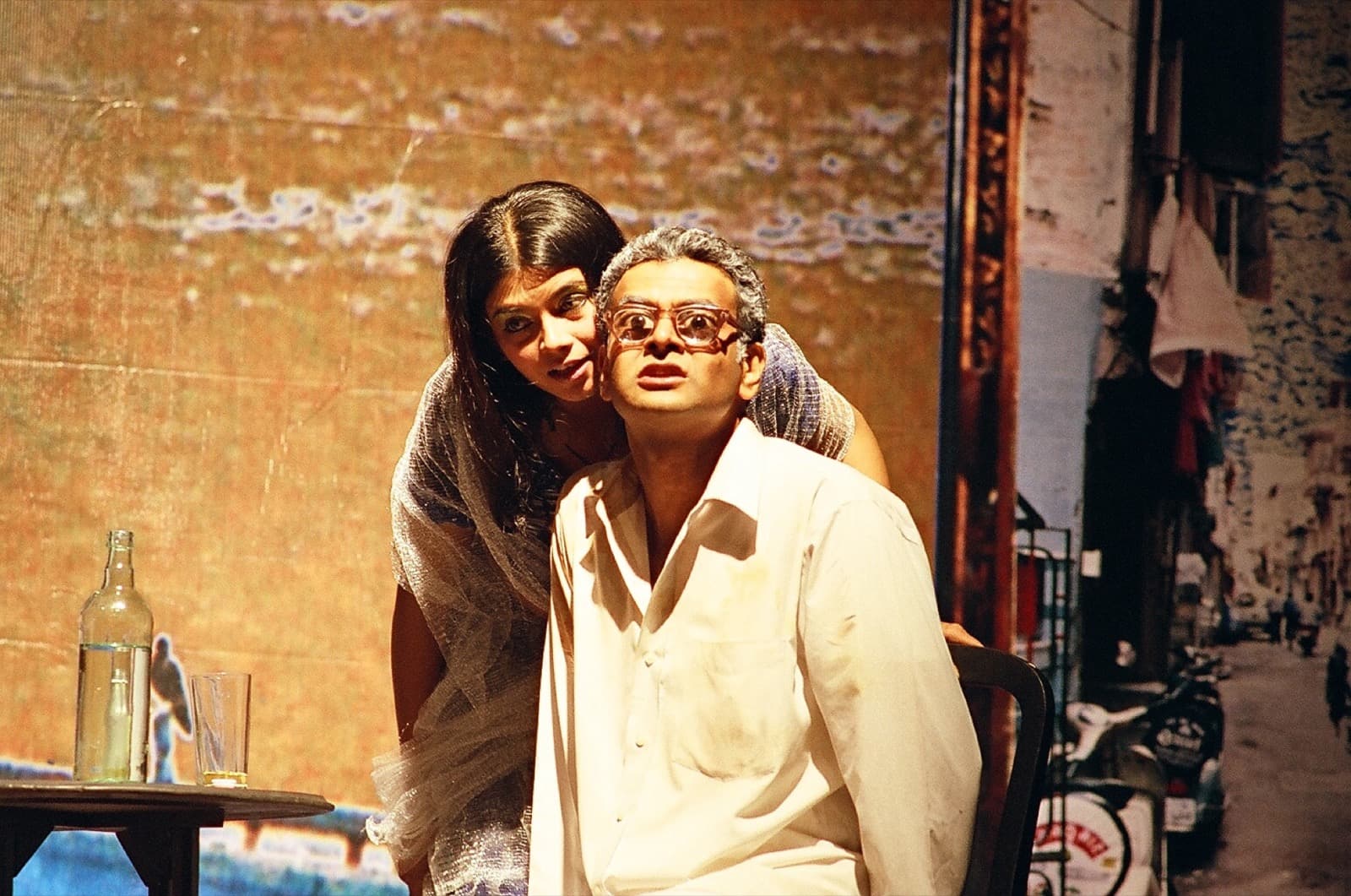
Mareez
Sufi on the Rock Since 2004
The longest-running Gujarati play. Two hundred performances and counting, at Prithvi Theatre continuously since 2004. Abbas Abdul Ali Vasi was born in Surat in 1917 into a Dawoodi Bohra family. He dropped out of school in the second grade. By fourteen, he was composing ghazals. By his twenties, he was selling them for five rupees apiece to wealthy men who published them under their own names. He drank. He loved a woman who would not love him back. He married another who stood by him. He contracted tuberculosis. He wrote 178 poems that the literary establishment ignored and the people of Gujarat memorised. His pen name was Mareez — literally, ‘a sick man.’ They called him the Ghalib of Gujarat. He died in 1983 after being hit by an auto-rickshaw on a Mumbai street. Adapted by Vinit Shukla from Raeesh Maniar’s biography Mareez: Astitva Ane Vyaktitva, and directed by Manoj Shah, the play does not tell this story in order. It weaves poetry, fantasy, hallucination, and realism into a theatrical fantasia — inspired by Vincent van Gogh’s letters Dear Theo and Charles Bukowski’s Barfly. Dharmendra Gohil has played Mareez since the 2004 premiere — twenty years in the same role — with critics noting that ‘Mareez was in his veins.’ Kumkum Das plays Sona, his wife. The set comprises six paintings by Padma Bhushan-awarded artist Ghulam Mohammed Sheikh. The music is by Uday Mazumdar, a tabla player trained under Ravi Shankar.
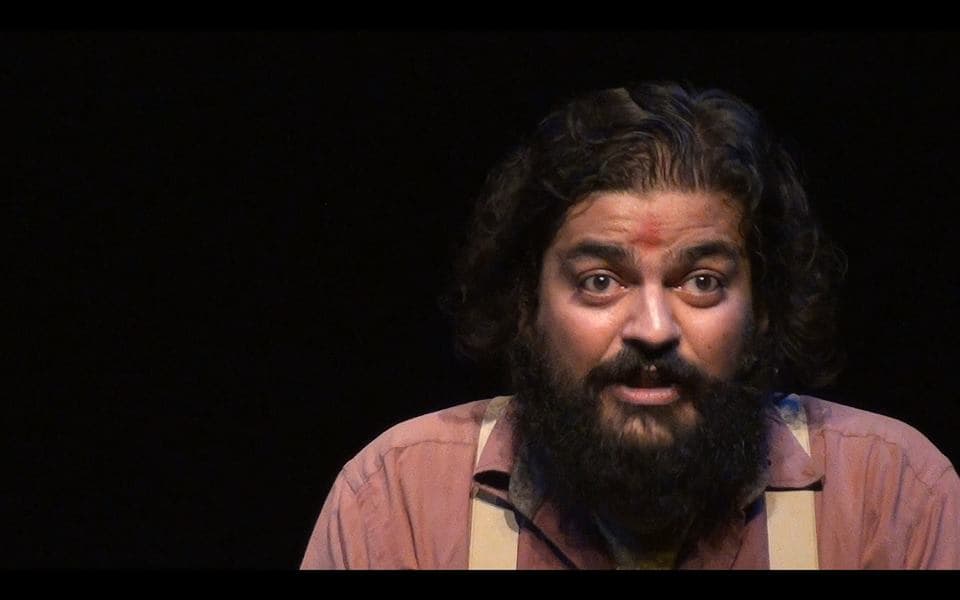
Karl Marx In Kalbadevi
Revolution via Entertainment
What happens when Karl Marx returns from the dead and lands straight into the buzzing chaos of Kalbadevi, Mumbai’s most unapologetically capitalist neighbourhood? He is furious. Not just about capitalism running wild or billionaires launching rockets — but because people have twisted his words, misused his ideas, and turned ‘Marxist’ into a punchline. He wants to set the record straight. But Mumbai is not in the mood for lectures. So he adapts. He rants, he jokes, he dances Gangnam Style, he reviews a Gujarati thali at Bhagat Tarachand, he learns Gujarati because of his admiration for Mahatma Gandhi, and he tries to visit Mani Bhavan only to find the gates shut. Written by Uttam Gada and directed by Manoj Shah, this one-man play has been Ideas Unlimited’s calling card for over twelve years. Satchit Puranik — who looks the part with his wild hair, beard, and a tilak on his forehead — brings a manic energy to Marx that makes the philosopher feel less like a historical figure and more like your most opinionated uncle at a family wedding. The play premiered at the NCPA Vasant Gujarati Natya Utsav in 2013, has since been performed in Gujarati, Hindi, and Hinglish, and staged at Wilson College for the 150th anniversary of Das Kapital, at Aligarh Muslim University, and at JAINA conventions in the United States. As Time Out Mumbai’s Deepa Gahlot put it: the play is ‘enough to provoke the audience to go back thinking, this Karlbhai was one clever dude, eh?’