
Gathariya
Kaleidoscope

Chandravadan Chimanlal Mehta — Chan. Chi. Mehta to everyone who read him — spent his life packing and unpacking. He was born in Surat in 1901, schooled in Vadodara and Surat, wrote more than twenty-five plays including Agagadi, joined Gandhi at the Bardoli Satyagraha in 1928, taught at New Era High School in Bombay, went into All India Radio in 1938 and ran its Ahmedabad station, started the first diploma and degree courses in theatre in India at M. S. University in Baroda, and travelled — Europe, America, theatre after theatre — until the travelling became the writing. The twelve volumes he made of it are all called Gathariyan: bundles, the cloth-tied bedroll a traveller slings over one shoulder. Bandh Gathariyan. Chhod Gathariyan. Safar Gathariyan. Natya Gathariyan, the one on theatre, took the Sahitya Akademi Award in 1971. Manoj Shah's play takes the title and the image literally. Pulkit Solanki plays Mehta alone on a bare stage with two bundles: one stitched out of patchwork the height of a man, one painted as a map of the world. He unties them and the life comes out of them in no particular order — a doll made for a child, a name given, the first day of school and the first punishment in it, a marriage he did not want, a train to Surat, Uttarayan kites over the roofs, Bardoli, a film projector, the Ila poems that move without warning between nursery rhyme and elegy, Vande Mataram, Bach's St Matthew Passion, New York jazz, and the long way home. Kanti Patel wrote it; Satya Mehta made the dramatisation; Kanhaiya's fifty-two-cue score carries the century the way the bundles carry the luggage. The play is subtitled Kaleidoscope, and it earns the word. There is no chronology to hold on to and no second actor to play against — only a man, his luggage, and Shekhar Phadke's light finding him in it. What holds is the voice: the appetite of a man who wanted to see every stage on earth and then tell Gujarat about it in Gujarati. It premiered at the Godrej Dance Theatre at the NCPA, Mumbai, at four in the afternoon on 27 March 2016 — World Theatre Day, the observance Mehta's own record says he moved the resolution for at the International Theatre Institute's congress in Vienna, under UNESCO. It later played Prithvi Theatre, Juhu.
Commissioned By
NCPA Mumbai
Made for Vasant Utsav at the NCPA and premiered in the Godrej Dance Theatre on World Theatre Day, 27 March 2016 — the date Chandravadan Mehta's own record credits him with proposing at the International Theatre Institute in Vienna.
The People
Behind
the Play
Also Worth
Seeing
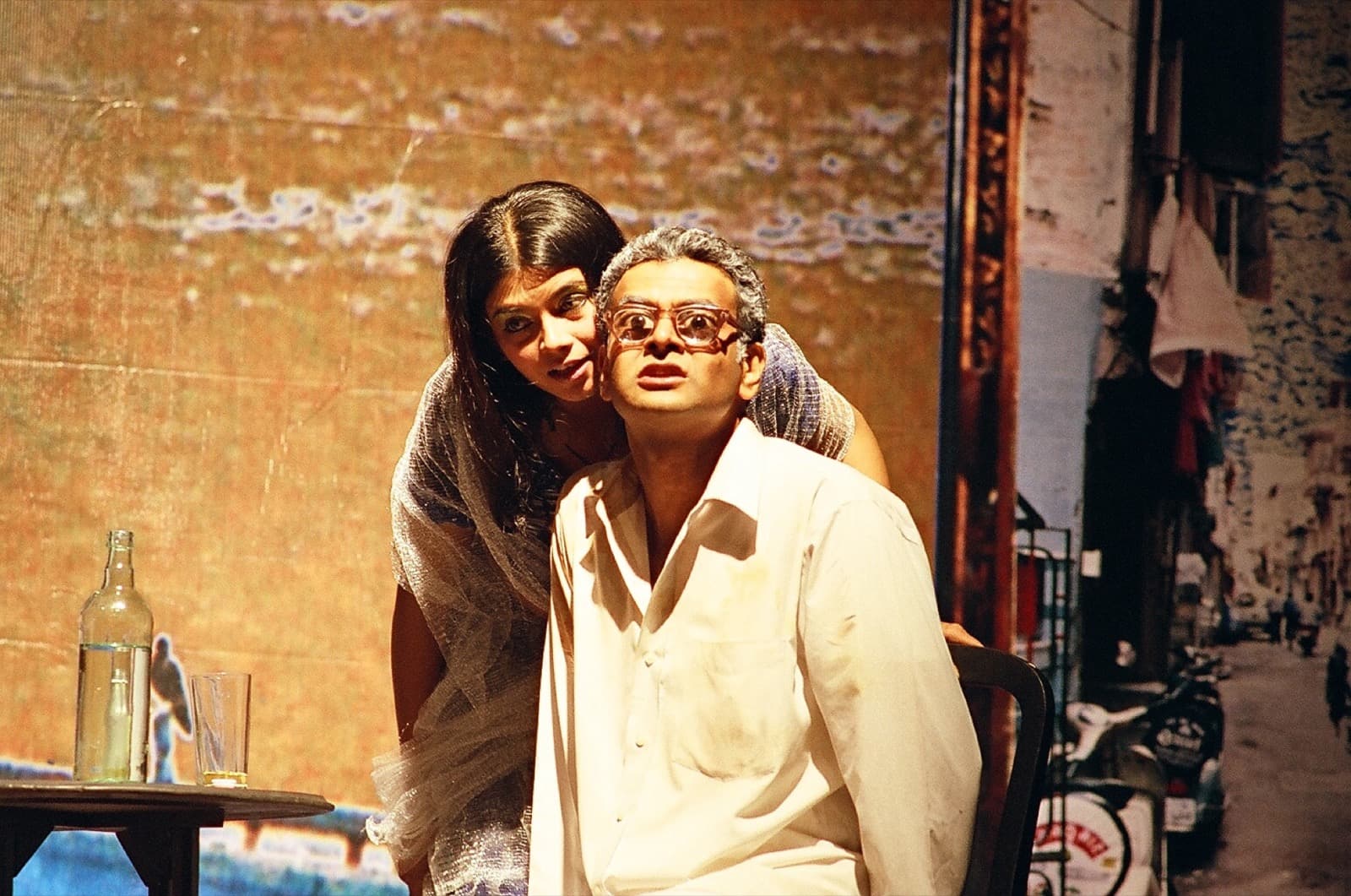
Mareez
Sufi on the Rock Since 2004
The longest-running Gujarati play. Two hundred performances and counting, at Prithvi Theatre continuously since 2004. Abbas Abdul Ali Vasi was born in Surat in 1917 into a Dawoodi Bohra family. He dropped out of school in the second grade. By fourteen, he was composing ghazals. By his twenties, he was selling them for five rupees apiece to wealthy men who published them under their own names. He drank. He loved a woman who would not love him back. He married another who stood by him. He contracted tuberculosis. He wrote 178 poems that the literary establishment ignored and the people of Gujarat memorised. His pen name was Mareez — literally, ‘a sick man.’ They called him the Ghalib of Gujarat. He died in 1983 after being hit by an auto-rickshaw on a Mumbai street. Adapted by Vinit Shukla from Raeesh Maniar’s biography Mareez: Astitva Ane Vyaktitva, and directed by Manoj Shah, the play does not tell this story in order. It weaves poetry, fantasy, hallucination, and realism into a theatrical fantasia — inspired by Vincent van Gogh’s letters Dear Theo and Charles Bukowski’s Barfly. Dharmendra Gohil has played Mareez since the 2004 premiere — twenty years in the same role — with critics noting that ‘Mareez was in his veins.’ Kumkum Das plays Sona, his wife. The set comprises six paintings by Padma Bhushan-awarded artist Ghulam Mohammed Sheikh. The music is by Uday Mazumdar, a tabla player trained under Ravi Shankar.
.jpg&w=3840&q=75)
Hu Chandrakant Bakshi
I, Chandrakant Bakshi
The story of Gujarati literature's most controversial writer, told by the man himself — or rather, by Pratik Gandhi inhabiting him with a ferocity that made audiences forget they were watching an actor. Chandrakant Bakshi (1932–2006) authored 178 books, served as Professor of History, became Sheriff of Mumbai, got his short story 'Kutti' banned by the Gujarat government, publicly defied Bal Thackeray and refused to apologise, and wrote an autobiography so incendiary that parts of it could not be published. His writing style — Gujarati laced with Urdu, Hindi, and English — was as deliberately provocative as his public persona. He was, by every account, an incredible egoist. He was also, by every account, adored by his readers. Written by Shishir Ramavat and drawn from Bakshi's autobiography Bakshinama, the play premiered on 15 June 2013 at Prithvi Theatre. Manoj Shah uses a ladder throughout the production as a metaphor for Bakshi's obsession with being on top. Gandhi — years before Scam 1992 would make him a household name — delivers what CreativeYatra called a 'cautious yet fearless' performance, bringing the bold and egotist protagonist to 'flawless perfection.' This play, along with Mohan No Masalo two years later, is credited with solidifying Pratik Gandhi's reputation as an actor of immense talent.
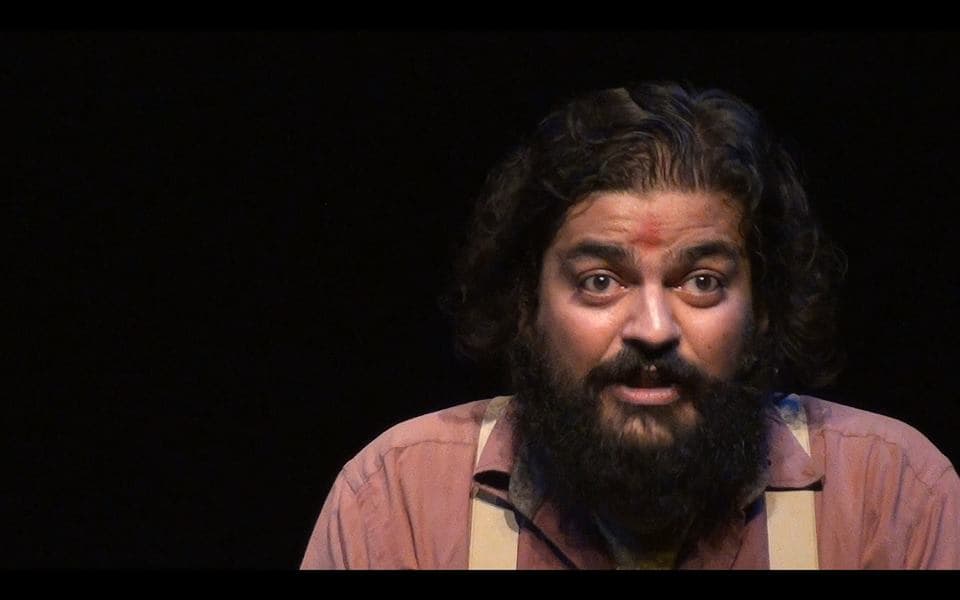
Karl Marx In Kalbadevi
Revolution via Entertainment
What happens when Karl Marx returns from the dead and lands straight into the buzzing chaos of Kalbadevi, Mumbai’s most unapologetically capitalist neighbourhood? He is furious. Not just about capitalism running wild or billionaires launching rockets — but because people have twisted his words, misused his ideas, and turned ‘Marxist’ into a punchline. He wants to set the record straight. But Mumbai is not in the mood for lectures. So he adapts. He rants, he jokes, he dances Gangnam Style, he reviews a Gujarati thali at Bhagat Tarachand, he learns Gujarati because of his admiration for Mahatma Gandhi, and he tries to visit Mani Bhavan only to find the gates shut. Written by Uttam Gada and directed by Manoj Shah, this one-man play has been Ideas Unlimited’s calling card for over twelve years. Satchit Puranik — who looks the part with his wild hair, beard, and a tilak on his forehead — brings a manic energy to Marx that makes the philosopher feel less like a historical figure and more like your most opinionated uncle at a family wedding. The play premiered at the NCPA Vasant Gujarati Natya Utsav in 2013, has since been performed in Gujarati, Hindi, and Hinglish, and staged at Wilson College for the 150th anniversary of Das Kapital, at Aligarh Muslim University, and at JAINA conventions in the United States. As Time Out Mumbai’s Deepa Gahlot put it: the play is ‘enough to provoke the audience to go back thinking, this Karlbhai was one clever dude, eh?’