
Kamrabhabhi No Barapo
The Outcry of Kamla

In the north Gujarat countryside the letter ળ softens into ર, and so Kamla becomes Kamra. The title is the joke and the whole play at once: Kamrabhabhi No Barapo — the outcry of Kamlabhabhi — is an evening of a woman complaining about her husband in a dialect that keeps mispronouncing her own name. Kamla's world turns on a single axis she never names directly. To anyone who will listen he is only "tamara bhai" — your brother. They started lower middle class and by the time he retired they had got as far as a second-hand car. The daughters are married off, the son works out of town, and Kamla has no leisure at all: she works while she talks, and everything she says is about him. Where is my towel. I cannot find my glasses. Kamra, where did you put the screwdriver. Thirty-seven years of putting the folded clothes in the same cupboard, and he still asks. She says she is fed up. What she is describing, sentence by sentence, is a life organised entirely around one man's comfort, and the complaint is how the affection gets said out loud. Then the play turns and hands him the stage. His name, he would like the audience to know, is Harshad Mehta — no relation, never bought a share in his life. He has been listening to all of it. The cotton wool he puts in his ears every morning after his bath is not for the draught; he took Best Actor prizes in college and has been performing partial deafness ever since he retired, because a man cannot read a newspaper while being told to count the cooker whistles. He has kept an accounting: forty tonnes of potatoes since the wedding, in every cut and configuration known to Gujarati cooking, which is why he had to learn to eat pickle. He knows every one of her techniques — a sari today, mohanthal tomorrow; a raised voice in the morning, dinner late at night. Reward and punishment, he says, like training a dog. And he knows she still half-suspects him about Bhavna from the neighbouring quarters, which was over before it began, forty years ago, because his job was private-sector and hers came with a government one. Manoj Shah directs and plays Harshad; Kalpana Shah plays Kamla and carries the bulk of the evening. Devanshu Pandit's script needs almost nothing on stage — a plastic chair, two people, a dialect — and it gets its comedy the hard way, out of observation rather than situation. There is no plot to spoil, because the marriage was never actually in dispute — only the question of who gets to describe it. Ideas Unlimited played it at the CCI in Churchgate and took it to the Hindustan Times Kala Ghoda Arts Festival in February 2017, where it was performed under Rang Savaari, the festival's Gujarati theatre strand.
The People
Behind
the Play
Also Worth
Seeing
What's Up?
One Man, One Flight, Too Many Calls
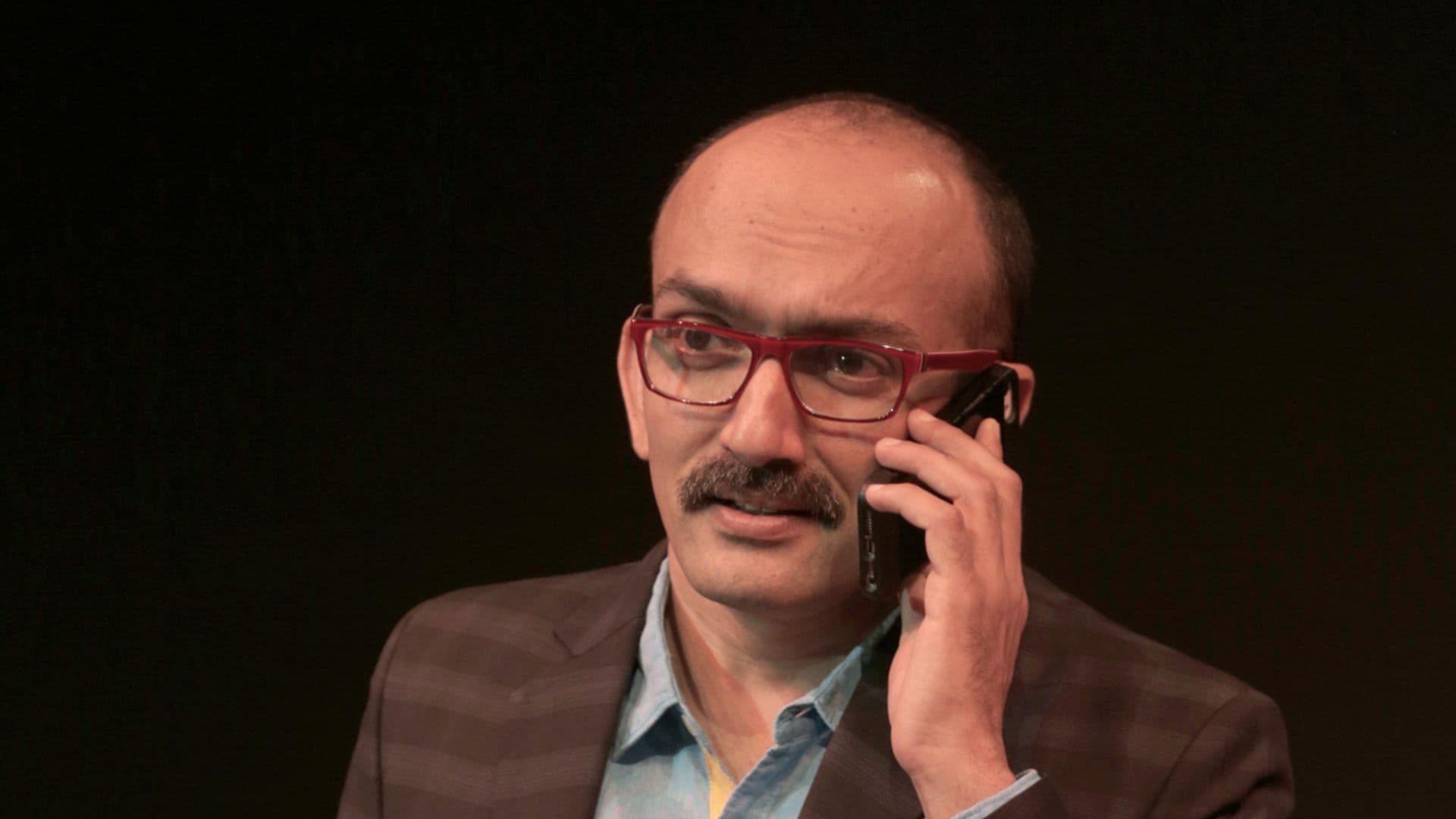
Meet Chirag — a perfectly average man in his early thirties with a single, noble mission: catch a flight to Chicago and save his not-so-bright brother from being thrown behind bars for a minor misunderstanding. But before he can zip up his suitcase, his girlfriend drops a bombshell. His phone starts ringing like it owes someone money. On the other end: his sister’s in-laws, an elite task force of relentless, nitpicking, drama-fuelled wedding planners who believe that unless Chirag approves the saree border and the sambharo menu, the marriage might as well be cancelled. From that moment, Chirag’s day turns into a high-stakes obstacle course complete with passive-aggressive aunties, conspiracy theories on family WhatsApp groups, emotional blackmail disguised as wedding prep, and the looming threat of missing his flight. He’s stuck between love and loyalty, Google Maps and Google Calendar, chai breaks and breakdowns. Written by Uttam Gada and directed by Manoj Shah, What’s Up? is a riotous solo comedy performed by Chirag Vohra — the original lead of Master Phoolmani. It premiered at NCPA’s CentreStage Festival in November 2015 and perfectly captures the madness of trying to keep everyone happy when no one knows what they actually want.
Gujarati Full Thali
Authentic Literary Test Preparation
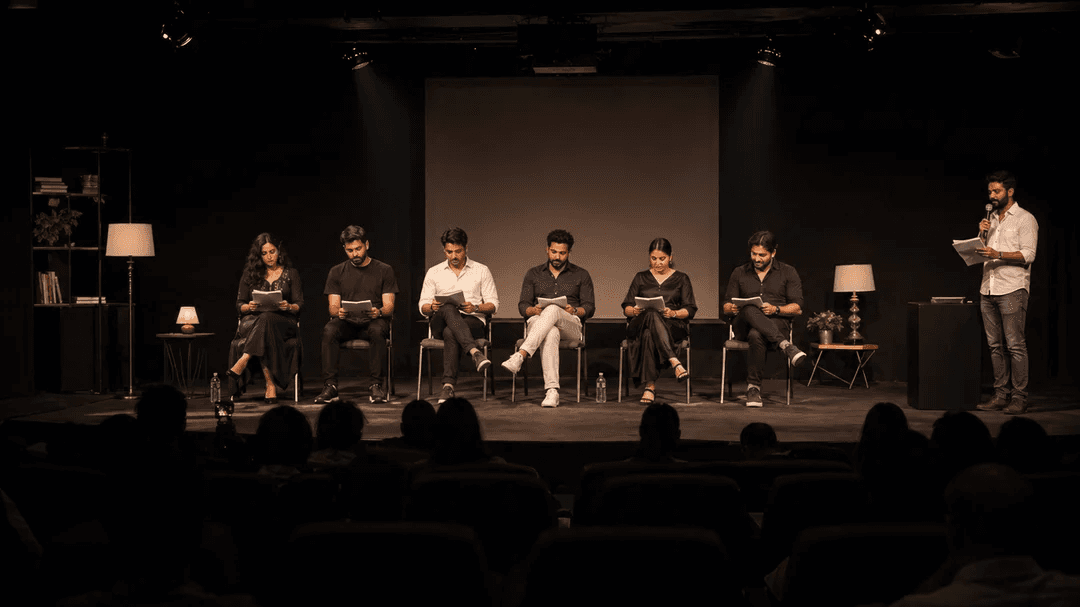
An NCPA Off-Stage presentation in collaboration with Ideas Unlimited — a curated literary feast in Gujarati, served by six storytellers, on one evening at Godrej Dance Theatre. Five writers form the roots of Gujarati identity in language, culture, and imaginative narrative. Five genres of writing speak to those of us standing in the void of an AI-shaped world. Five known actors carry these stories onto stage — reading, performing, framing the language, the culture, and the people of Gujarat back into the room. Inspired by the literary flavours of Hemansi Selat, Ghanshyam Desai, Gulam Mohmmed Shaikh, Madhu Rai, Pavankumar Jain, and Sharifa Vijliwala — six voices that span fiction, poetry, the visual-literary, and the experimental. The stories are served by Hemant Kher, Harsh Joshi, Kalpana Shah, Priyank Patel, Unnati Gala Joshi, and Utkarsh Mazumdar, with narration by Bakul Tailor and direction by Manoj Shah. Box office opened 26 April for NCPA members and 29 April for the public.
Lagan Magan
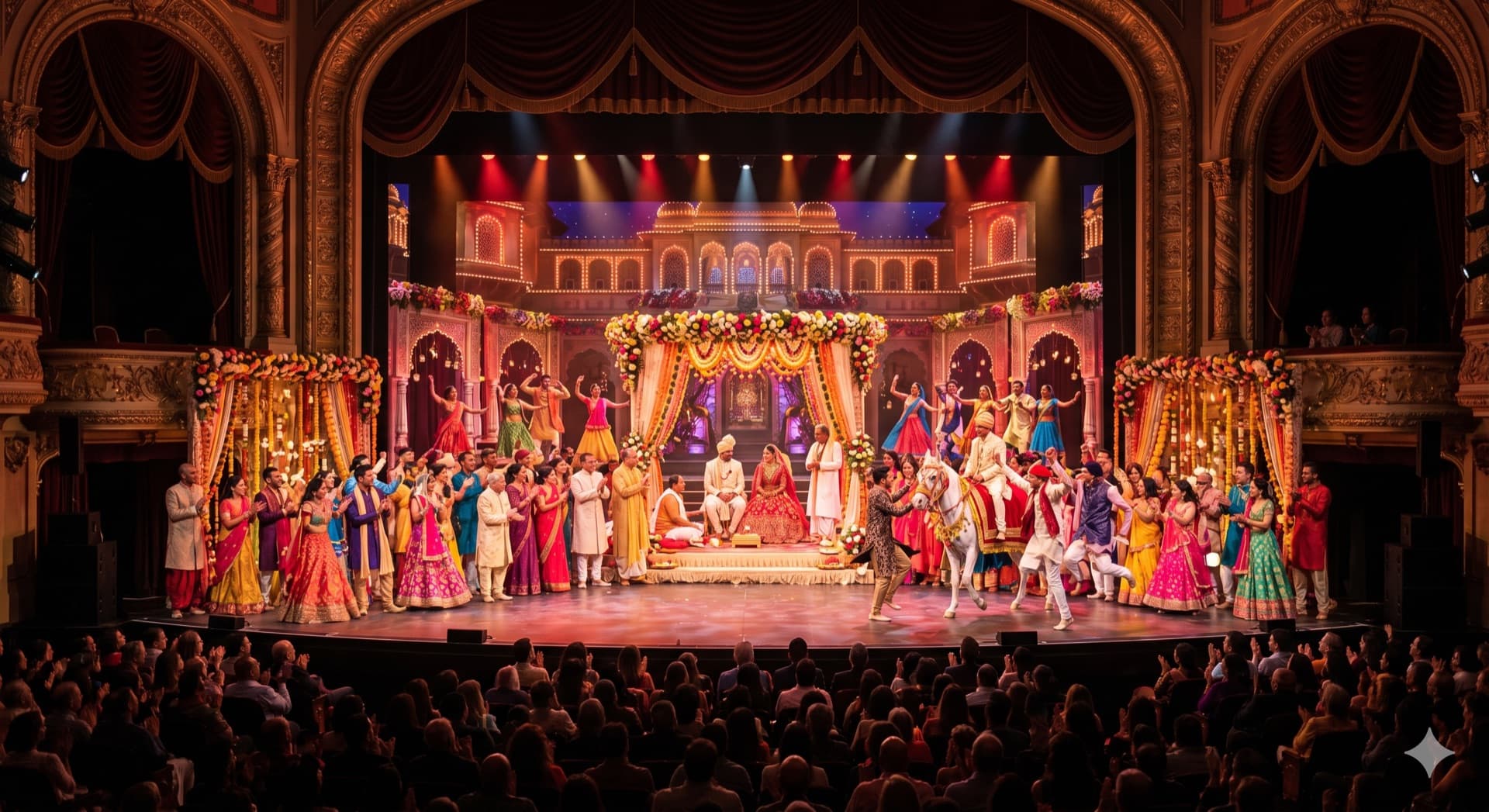
Lagan Ma Magan turns a grand Gujarati wedding venue into the epicentre of joyous chaos, where multiple families from different regions arrive to celebrate a series of marriages. Each family carries not only its own customs and traditions but also its distinct dialect — turning every conversation into a lively mix of familiar phrases, amusing misinterpretations, and unexpected linguistic clashes. As the celebrations unfold, the differences in dialect become both a source of humour and tension. What sounds like an argument to one family is just an animated discussion to another. Affectionate phrases are mistaken for sarcasm. Wedding rituals become battlegrounds of speech, where words hold as much power as emotions, and every blessing arrives with a pronunciation problem. As the dance, the music, the endless festivities, the laughter and the shared moments take over, the play quietly insists that dialects — though different — are threads of the same cultural fabric. Lagan Ma Magan is finally a celebration of linguistic diversity, proving that love and family always find a common language, no matter how different the words may sound.