Siddha Hem: The Play That Opened in California Before It Ever Played in Gujarat
The poster was a blue elephant. Not a decorative elephant — a specific one. When Siddharaja Jayasimha of the Chaulukyas finally got the grammar he had been demanding, he had the manuscript placed on his favourite elephant and paraded through the streets of Patan. That is the image Ideas Unlimited chose for a play about a book, and it is a fair summary of the problem the play set itself: how do you stage the writing of a grammar and make two thousand people stay in their seats for it?
The grammar was the Siddha-Hema-Shabdanushasana. The man who wrote it was Acharya Hemchandra, and almost nobody outside a small circle of Jain scholarship can tell you anything about him, which is the second problem the play set itself.
Here is the shape of the life. He was born around 1088 at Dhandhuka in Gujarat and named Changadeva. A Jain monk called Devachandra Suri saw something in the boy, and the boy's father — a merchant, away on a voyage when it happened — came home to find his son gone to the order. He was initiated at Khambhat as Somachandra, ordained acharya at twenty-one at Nagaur, and renamed Hemachandra Suri. He served two kings, Siddharaja Jayasimha and then Kumarapala, from inside a monastic vow. He was given the title Kalikalasarvajna — the one who knows everything in this age. He died around 1172 at Anhilwad Patan, by sallekhana, having fasted himself out of the world.
In between he wrote an amount of material that nobody has ever counted twice the same way. Ideas Unlimited's own synopsis put it at thirty million shlokas across eighty-four years; the American press covering the play in 2009 said three and a half million. The list of titles, at least, is not in dispute: the Siddha-Hema-Shabdanushasana, a grammar covering six languages including the Apabhramsha that became Gujarati; the Yogashastra; the Trishashti-shalaka-purusha-charitra, an epic on sixty-three illustrious Jain figures; the Dvyashraya Kavya, a history of the Chaulukya dynasty written so that it doubles as a grammatical exercise; the Abhidhana Chintamani, a lexicon; treatises on prosody and on poetics. Georg Bühler, the Austrian indologist, spent enough of his life on this to publish a monograph in Vienna in 1889 — Über das Leben des Jaina-Mönches Hemachandra — which is still the standard biography, and which Manilal Patel translated into English at Santiniketan in 1936.

The grammar came out of a war. In 1135 Siddharaja took Malwa, and among the spoils he found the manuscripts of Bhoja's Sanskrit grammar. The story the play tells is that the conquest humiliated him rather than pleased him: Malwa was so rich in language and heritage that its people had barely registered a change of ruler, and Gujarat had nothing comparable to hold anyone. So he asked for a grammar of his own, and Hemachandra wrote it, and the elephant went through Patan.
The other thing Hemachandra did, and the thing that ought to make him famous outside Gujarat, was arithmetic he did not think of as arithmetic. Around 1150, working on a problem in Sanskrit prosody — in how many ways can short and long syllables be arranged to fill a line of a given length? — he arrived at the recurrence f(n) = f(n−1) + f(n−2). The MacTutor History of Mathematics archive at St Andrews, which keeps a biography of him among the mathematicians, notes that this is the Fibonacci rule, set down roughly fifty years before Fibonacci published the Liber Abaci in 1202, and that Indian mathematicians had been circling the same sequence since the seventh century. A monk counting metres got there first.
Ideas Unlimited had been building towards this. Apurva Avsar, its play on Shrimad Rajchandra, had opened at Prithvi Theatre in 2007 and gone to the JAINA Convention in New Jersey that summer, where it did very well; Hemachandra appears in that play too, one of three figures spanning 2,500 years of Jain thought. Siddha Hem was the follow-up, and JAINA commissioned it for the next convention. The brochure was blunt about the pitch: Apurva Avsar stole your heart, Siddha Hem shall capture your soul.
Johny Shah wrote it. Chitralekha's report on the premiere describes his method, and it is the least glamorous and most convincing part of the whole story: he went to Khambhat, where Hemachandra was initiated and did much of his life's work, and to the country around it, and he found every scholar who could tell him anything at all about the Acharya, however small, and asked them. The company's research file from 2008 survives in its archive and is a snapshot of what that looked like from the other end — a list of URLs, jainworld.com and herenow4u.net and jainuniversity.org and the St Andrews mathematics biography and, inevitably, Wikipedia. A play about the man who systematised a language, assembled from scraps.
The problem with a biography of a polymath is that it has no plot. Johny Shah's solution was a frame. Motichand Girdharlal Kapadia — a real Bombay Jain scholar and editor — is in jail as a political prisoner during the freedom struggle, and picks up a book about Hemachandra to use up the hours. He gets so far into it that he stops reading and starts narrating: he becomes the Sutradhar, and the play is what he sees.

What he sees is episodic and unashamed of it. A thief's soul turned around by a single sermon, lifted out of the old Sanskrit play Prabuddha Rauhineya. Chachiga home from his voyage, and Udayan Mantri explaining to a bereft father what his son is going to become. Pahini Devi, the mother, left to carry the actual cost of the family's contribution to history. Siddharaja back from Malwa in a foul mood. The eight great treatises fetched from Kashmir. Brahmin courtiers making it very clear that a Jain monk at court is not welcome, and Hemachandra walking into the Mahadev temple to say, in front of all of them, Brahma ho, Mahadev ho, Vishnu ho ke Jin ho, temne namaskar thao — whether you are Brahma or Mahadev or Vishnu or Jina, salutations to you. Kumarapala named heir against his king's wishes. Animal sacrifice abolished, and with it the practice of seizing a widow's property.
The character list ran to twenty-five and did not stay in the twelfth century. Max Müller is in it. So are Peterson, Sir William Jones, Lokmanya Tilak and the philologist Harivallabh Bhayani. The script used five languages — Gujarati, Hindi, Prakrit, Sanskrit and German — which is an unusual demand to make of eleven touring actors, and the German is there because Bühler is a character. At the end Bühler and Albert Einstein arrive in Motichand's vision, Bühler to talk about the non-violence he put into his German book and Einstein — this is the play's claim, and it belongs to the play — to talk about syadvada, the Jain doctrine of qualified assertion, and how close it sits to relativity and probability. Then Pahini Devi walks in nine hundred years late, looking for her son, afraid the world has forgotten him. Motichand has no answer for her except the one the play has been building to: her son is still here, in the language everyone in the room is speaking.
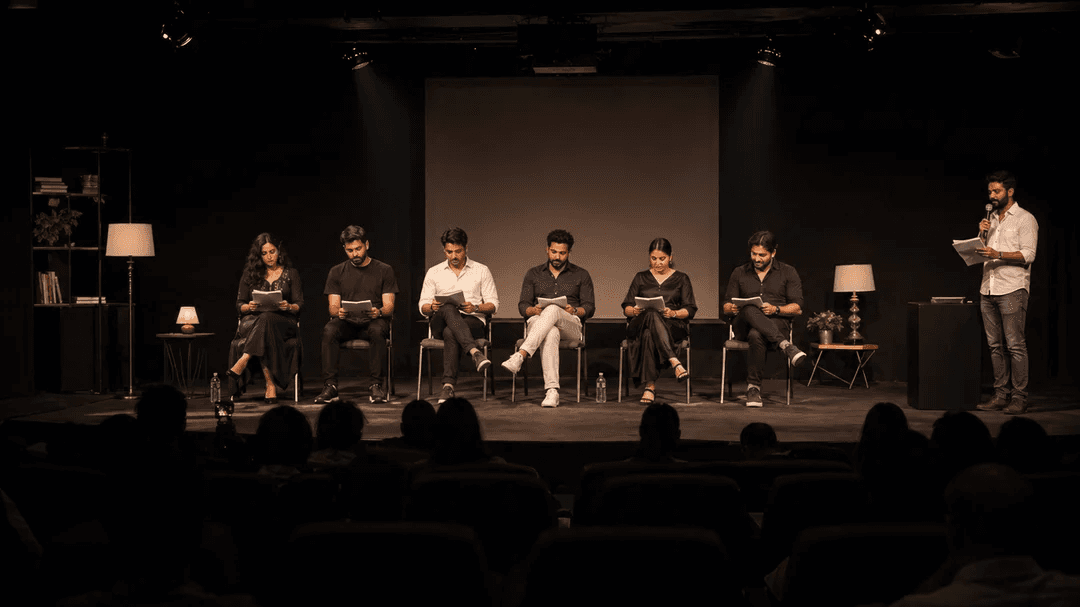
Manoj Shah directed it, with Dharmendra Gohil in the lead. It ran two hours.

It opened on 3 July 2009 in the newly built Jain Bhavan of the Jain Center of Southern California, at Buena Park in greater Los Angeles, as part of the 15th Biennial JAINA Convention — 2,500 delegates, from the United States and Canada and from Britain, Dubai and India, gathered under the theme Ecology — The Jain Way. The conveners' message in the souvenir, which the Jain Quantum archive has digitised, called it simply the convention's unique play: the world premiere of a work based on the life and works of Acharya Hemachandracharya, by the Apurva Avsar team.
The audience began queueing at five in the afternoon for a performance at half past seven. Chitralekha's correspondent Ketan Mistry reported that the hall filled so far past capacity that the organisers had to run a live telecast on the upper floor of the cultural complex for the people who could not get in. It closed to a standing ovation, and by the end of the evening more than eight American Jain centres had asked for it. The South Asian Times, covering the convention, recorded what that actually meant: a major Gujarati play produced in India by an Indian company had given its world premiere in the United States before playing a single show at home. Whatever else Siddha Hem was, that had not happened to Gujarati theatre before.
The tour that followed ran under JAINA's promotion until the middle of August. Chicago on 11 July, San Francisco on 18 July, Boston on 25 July, then New Jersey. It nearly did not happen at all: the company's visa interviews had been scheduled for 14 July, ten days after the play was due to open, and JAINA's president had to write to the American Consulate General in Mumbai asking for an earlier date.

Nine hundred years is a long time for a reputation to thin out. Hemachandra regularised a language that seventy million people now speak, wrote its first grammar, gave a king a literature to be proud of, argued a court out of animal sacrifice, and found the Fibonacci numbers in a question about poetry. The play's own tagline for all this was: reintroducing you to yourself. It is not a modest claim, but for an audience of Gujarati speakers watching a play about the man who fixed their grammar, in a hall in California, it was more or less literal.
.JPG&w=3840&q=75)