Mareez: The Poet Who Sold His Ghazals for Five Rupees and Became Immortal
On 16 November 2004, a play opened at Prithvi Theatre in Mumbai. Twenty years later, it is still running. Two hundred performances. The same actor in the lead role. The same director. The same six paintings by Ghulam Mohammed Sheikh serving as the set. The same music by Uday Mazumdar. The play is Mareez, and it is the longest-running Gujarati play in existence.
Abbas Abdul Ali Vasi was born in the Pathanwada area of Surat in 1917, the third of eleven children in a Dawoodi Bohra family. His father taught at a Madrasah. His mother died of tuberculosis when he was young. He dropped out of school after the second grade. At fourteen, inspired by his elder sister Rukhaiya’s recitations of the Urdu poets Anis and Dabeer, he composed his first poem. His mentor Ameen Azad gave him the pen name Mareez — literally, ‘a sick man.’ It would prove more accurate than anyone intended.
By his twenties, Mareez was frequenting the Zhapa Bazar in Surat, where ghazal enthusiasts gathered. He moved to Mumbai in 1932, worked in a rubber shoe factory, drifted through journalism, and began selling his ghazals to wealthy patrons who published them under their own names. Five rupees a ghazal. The tea-house audiences of Mumbai memorised his verses. The literary establishment ignored him. He drank. He loved a woman who would not love him back — a cousin whose family rejected his proposal because of his drinking and smoking. He married Sona, who stood by him. He contracted tuberculosis. He was, in every sense of the word, Mareez.
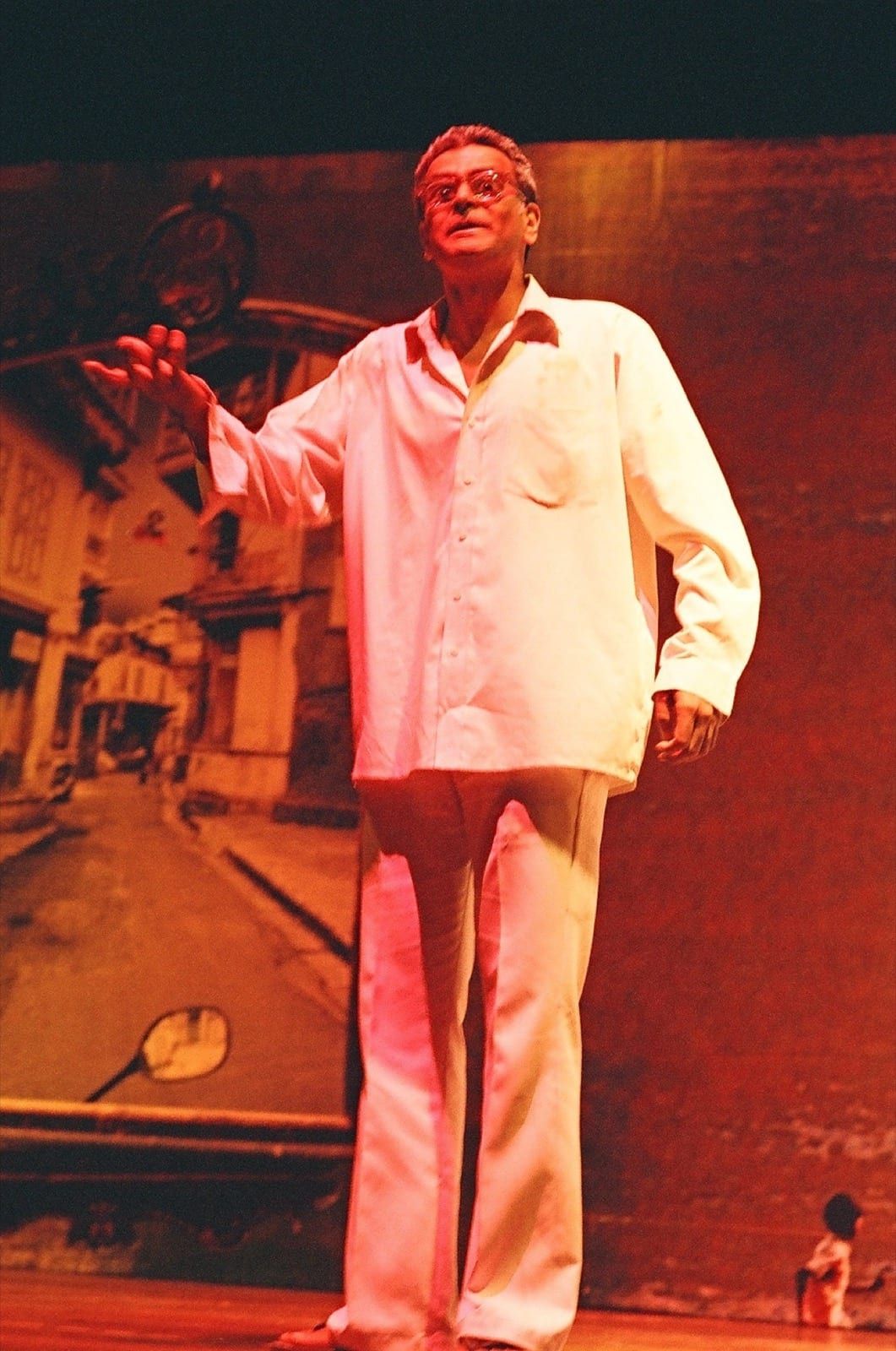
The play, adapted by Vinit Shukla from Raeesh Maniar’s biography Mareez: Astitva Ane Vyaktitva, does not tell this story in sequence. It moves the way a ghazal moves — through feeling, not chronology. Hallucinations interrupt memories. Poetry dissolves into dialogue. A child-Buddha appears offering Mareez middle-class salvation. Time collapses. The structure owes as much to Vincent van Gogh’s letters Dear Theo and Charles Bukowski’s Barfly as it does to any Gujarati dramatic tradition.
Dharmendra Gohil has played Mareez since opening night — twenty years in the same role. The critic Utpal Bhayani wrote that ‘Mareez was in his veins.’ Deepa Punjani at Mumbai Theatre Guide called his performance ‘simple yet effective and evocative,’ ranging from the charismatic young poet to the broken alcoholic. The transformation happens not through makeup or costume changes but through the body — the way Gohil carries himself shifts from expansive and burning to hunched and hollowed as the play progresses.
Kumkum Das plays Sona with a stillness that counterbalances Gohil’s restless energy. Where he spirals and burns, she endures. Her silence speaks as loudly as his poetry. Dayashankar Pandey appears as Saadat Hasan Manto — another tormented writer, another man destroyed by the gap between his talent and his circumstances. Aishwarya Mehta plays Rabab, the girlfriend. Jay Upadhyay, Darshan Pandya, Huseini Dawawala, and Pradeep Vengurlekar fill out the ensemble of fifteen actors.
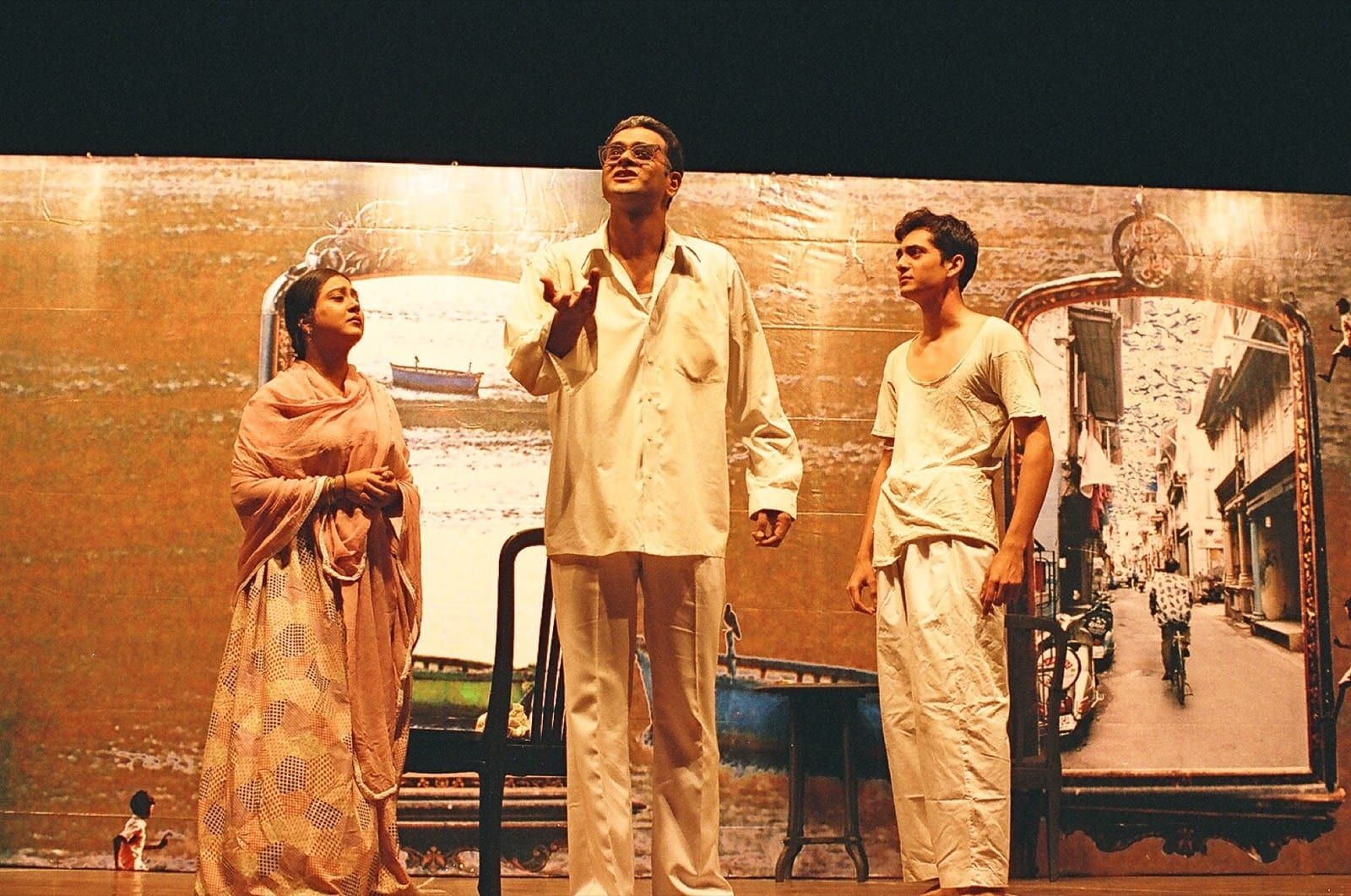
The visual design is by Ghulam Mohammed Sheikh — the Padma Bhushan-awarded painter from Vadodara whose work hangs in the Victoria and Albert Museum and the National Gallery of Modern Art. His six paintings for Mareez are not decoration. They are the world of the play. The actors move within and against depictions of the streets and mehfils of Surat and Mumbai. This was the second collaboration between Shah and a major painter, after Bhupen Khakhar’s backdrops for Master Phoolmani.
Mareez the poet died on 19 October 1983. He was hit by an auto-rickshaw on a Mumbai street on 13 October and died six days later of a heart attack during surgery. He was sixty-six. His first collection of ghazals, Aagman, had been published only eight years earlier, in 1975. His complete works were not published until 2012. He received the Premanand Suvarna Chandrak — one of the most prestigious awards in Gujarati literature — posthumously, in 1984.

The play’s subtitle is ‘Sufi on the Rock Since 2004.’ It is a perfect description. Mareez is not comfortable theatre. It does not redeem its subject. It does not sentimentalise addiction or romanticise poverty. It shows a man who was brilliant, self-destructive, exploited, and fearless — a man who wrote poetry of such intensity that people memorised it in tea houses, and yet who could not feed himself. The play asks no one to pity him. It asks them to listen. Two hundred times, audiences have listened. They keep coming back.