Master Madam: India's Oldest Comedy Is a Body-Swap Farce
The oldest surviving comedy in Indian theatre is about a monk and a sex worker who accidentally swap souls. It is roughly 1,600 years old. It was written before anyone in Europe had thought of the device, and it is funnier than most things written since.
The play is Bhagavadajjukam — something like “the reverend and the madam,” which is why Ideas Unlimited called their version Master Madam. Tradition attributes it to a playwright named Bodhayana about whom nothing else whatsoever is known; the attribution survives only because later commentators wrote it down. Inscriptional and scholarly evidence points elsewhere, to the Pallava king Mahendravarman I, who reigned in the early seventh century and certainly wrote the other great surviving Sanskrit farce, Mattavilasa Prahasana. Between them, those two plays are the entire surviving corpus of the form.
The form matters, because it is itself the joke. The prahasana is one of the ten types of drama catalogued in the Natyashastra: a short satire, and unlike almost everything else in the Sanskrit canon its targets are not kings or gods but holy men — ascetics, priests, mendicants, the professionally pious. Sanskrit drama had a licensed genre for making fun of religion, and two examples of it have come down to us. Master Madam is one.
Bhagavadajjukam was effectively forgotten everywhere in India except Kerala, where it entered the repertoire of Kutiyattam, the oldest continuously performed theatre tradition in the world. There it was not a two-hour comedy but a ritual event: the complete performance ran for weeks, by some accounts thirty-six days, embedded in temple observance. The three-hour version now staged is a twentieth-century edit by Painkulam Rama Chakyar. UNESCO named Kutiyattam in its very first list of Masterpieces of the Oral and Intangible Heritage of Humanity in 2001. So the play has an unbroken performance history and almost no reputation — a classic that never became one.

It has travelled in fragments. There is a Telugu translation from 1924, an Italian one from 1932, an English one from 1971. In 1967 Shanta Gandhi directed a Hindi production at the National School of Drama; Gandhi was the great modern reviver of ancient Indian drama in India, and her landmark work was Jasma Odan, a Gujarati legend staged in the Bhavai idiom. Kavalam Narayana Panicker brought it back to a Kochi stage in 2011. The route from Sanskrit text to a living regional theatre language is one that had been walked before Manoj Shah walked it — but not, before 2013, into Gujarati.
In 2013 the Prithvi Theatre Festival programmed its edition around world classics. Shah's response was to point out that one of the world's classics was sitting unread in Sanskrit.
Prithvi is a small house in Juhu — a couple of hundred seats around a stage barely twenty-six feet wide — and its festival is the closest thing Bombay theatre has to a shared calendar. A Gujarati company taking a Sanskrit farce there, in a year given over to world classics, was making a quiet argument about what counts as one.
The plot is a machine, and it is worth laying out because the comedy is entirely in its gears. A sadhu has practised yoga to the point of believing his soul can leave one body and enter another at will. A ganika — a courtesan — believes her body can get her anything she wants. Those are the play's two theories of the self, and it is going to test both by switching them.
Yamraj, god of death, is working through the day's quota of souls with his assistant. He makes a clerical error: sent for the courtesan's friend, he takes the courtesan herself, and gets a dressing-down from Chitragupta, heaven's accountant, over the paperwork. Down on earth the sadhu's assistant Shandilya — sceptical, worldly, entirely uninterested in his master's discipline — dares him to prove the powers he keeps talking about by bringing the dead woman back. The sadhu obliges, and moves his own soul into her body. Yamraj returns to correct his mistake, finds that body already tenanted, and does the only tidy thing available: he puts her soul into the sadhu.

What follows is two people living in the wrong bodies and unable to stop being themselves. The ascetic, in the body of a courtesan, has to conduct her business. The courtesan, in the body of an ascetic, has to be revered. Neither the discipline nor the appetite transfers. The joke lands where a philosophical argument would: whatever a person is, it is not the body — and it is not cleanly separable from it either.
Metamorphosis is one of literature's oldest engines — Ovid built a whole poem out of it, Kafka opened his most famous story with it, and Hollywood has been remaking Freaky Friday for half a century. Almost all of those transformations are punishments or accidents visited on one person. Bhagavadajjukam does something structurally harder and considerably funnier: it swaps two people who are each other's opposite, and it makes the swap a bureaucratic error rather than a curse. Nobody is being taught a lesson. Somebody just filled in the wrong name.
The Gujarati version is more faithful than its title suggests. The courtesan keeps her Sanskrit name, Vasantsena. The original's supporting cast — her lover, her mother, her maidservants — survives as the prince Rajkumar, the mother, and her confidante Kanakchitra. What Shah changed was register, not architecture.
Because the staging kept the argument and dropped the reverence entirely. Yamraj argues in colloquial Hindi, then Gujarati, then Marathi, then English, depending on who is annoying him. Shandilya is a devotee of one Swami Rajnikanteshwar and has acquired disciples of his own, to whom he dispenses his worldly gyaan. Reviewing the production for MumbaiTheatreGuide, Pratik Kothari described the method precisely: when you work on a classical text it is difficult to make contemporary audiences connect to the characters and the situations, so here the characterisations were modelled to break that barrier, and the characters speak the way we do today.

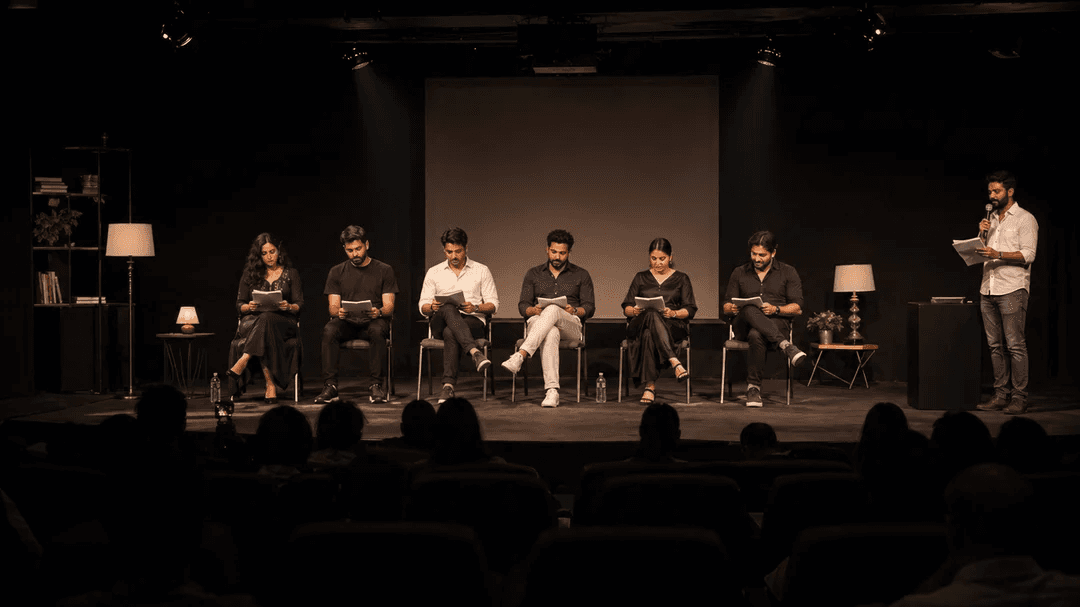
The physical production was close to nothing. Kabir Thakore painted a backdrop of a tree and hung green cloth; Shekhar Phadke's lighting cut the bare Prithvi floor into separate zones and tones; Kanhaiya wrote the score; Akash Naik choreographed the movement. On a stage with no furniture to hide behind, the evening is carried by ten actors and a gada — Yamraj's golden mace, which spends much of the play lying on the floor like an abandoned tool.
Pratik Gandhi played the Master, two years before Mohan No Masalo and long before Scam 1992 made him a household name, and the review's verdict on him was a single sentence: he flows smoothly from Master to Madam. Aishwarya Mehta played Vasantsena. Jay Upadhyay played Shandilya and was, by Kothari's reckoning, the most enjoyable character in the play — perhaps because he is the most human of all. Pradeep Vengurlekar's Yamraj and Alpesh Dikshit's Chitragupta ran the celestial bureaucracy. Vaishakhi Shukla Dave played Kanakchitra, Kalpana Shah the mother, Ishan Doshi the prince, Nimesh Mehta the character called Paado, with Gopal Parmar, Kaushal Desai and Amit Dhabliya as disciples.
The adaptation was credited to four people — Will Johnson, Dr. Vijay Pandya, Abhishek Khelkar and Satya Mehta — and was, as Kothari noted, largely improvised on top of that written base. The script files from the rehearsal period show the shape of it: successive drafts through October 2013, characters renamed between versions, a confidante who is Chitralekha in one draft and Kanakchitra by the time the cue sheet was typed.

That method is the through-line of the repertoire. Ideas Unlimited had already brought Tagore's most awkward play into Gujarati as Achalayatan and taken it to Kolkata as the only non-Bengali production in a Tagore festival; a year after Master Madam it would find the one major Ibsen nobody had staged in the language and make it Master Builder. Shah's instinct is not to modernise a classic but to find the one nobody has claimed and hand it to a room full of actors to argue with.
The poster was the cleanest statement of intent. Two profiles — a woman's and a moustached ascetic's — share a single black silhouette that reads as her hair and his beard at the same time, so you cannot see one face without the other. Above it, the line: you can't call it religion, and you can't call it prostitution, better call it Master Madam.
Master Madam ran 120 minutes with an interval and carried an advisory of sixteen and above, which is about what a 1,600-year-old farce concerning souls and bodies deserves. The prahasana existed to make fun of precisely the people who would object to it. Whoever wrote Bhagavadajjukam — Bodhayana, or a Pallava king with a taste for comedy — put a monk and a courtesan on a stage and swapped them to find out which of the two was the fraud. The play declines to answer. That is the joke, and it has survived sixteen centuries intact.
.JPG&w=3840&q=75)