Maitribhaav: The Monk Who Crossed the Ocean
There is a prayer that Gujarati schoolchildren sing at morning assembly without ever being told where it came from. Maitri Bhavnu Pavitra Jharnu — may the sacred stream of friendliness flow forever in my heart. It is sung in Jain derasars, in schools, in ashrams that have no connection to Jainism at all. Mukesh, the Bollywood playback singer, recorded it in the 1960s, and that recording is still the one most people carry in their heads.
The man who wrote it was a monk who would later be told he could no longer be one.
His name at birth was Rup-Rajendra Shah. He was born in July 1922 in Takhatgarh, a small town in the Pali district of Rajasthan. His mother died when he was a boy. His sister died not long after. Grief arrived early and stayed, and it is the thing that pushed him toward the question he would spend the rest of his life inside: what exactly is a person, and what is any of this for.

In February 1942, at the age of twenty, he took diksha at Palitana, in the shadow of Shatrunjaya hill — the most sacred site in Jain geography, a mountain carrying nearly nine hundred temples. He was given the name Muni Chandraprabh Sagar. He would carry it for twenty-nine years.
Those years were spent the way Jain monks have always spent them: walking. No vehicles, no shoes, no possessions beyond a bowl and a mouth-cloth. He walked across Rajasthan and Gujarat, down into the south as far as Mysore, staying nowhere long. He also read — far more widely than his order expected. He studied psychology. He read Western philosophy. He wrote, including the prayer that would outlive every other thing he made.
Then, in 1970, the Temple of Understanding invited him to address the Spiritual Summit Conference in Geneva.
This was not a straightforward invitation. Jain monastic vows do not permit travel by vehicle, and they certainly do not permit crossing an ocean. No Jain monk had ever addressed an audience in the West, because no Jain monk could get there. To accept was to stop being a monk.
He accepted. He flew to Geneva in 1970, and in 1972 he spoke at Harvard Divinity School. He gave up his monkhood to do it and returned to the status of an ordinary shravaka, a lay follower. In 1971 he married Pramoda Shah. In 1973 he founded the Jain Meditation International Center in Manhattan, which is where the bulk of Jain practice in North America can trace its beginnings. His book Twelve Facets of Reality: The Jain Path to Freedom introduced a generation of American readers to Jain thought.
He was, depending on who you asked, either the man who broke the tradition or the man who saved it. He died at his home in Mumbai in April 2019, aged ninety-six.
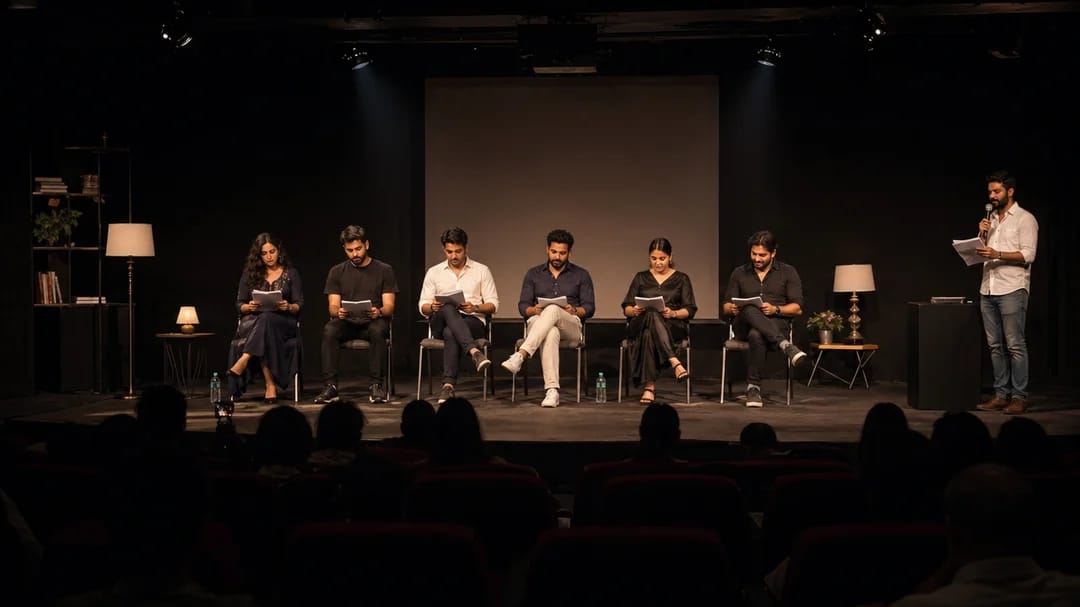
This is the life that Maitribhaav puts on a stage, and it is not an obvious choice for one. A biographical play about a religious figure tends to collapse into either hagiography or lecture. Manoj Shah has spent thirty-five years building productions out of exactly this kind of difficult material — Shrimad Rajchandra in Apurva Avsar, the Jain poet Anandghan in Apoorav Khela, the merchant who funded Mewar's resistance in Bhamasha — and the method has always been the same: find the human being underneath the reverence, and let him talk.
The script is by Abhimanyu Acharya, a playwright from Surendranagar whose short story collection Padchhayao Vacche took both the Yuva Puraskar and the Gujarat Sahitya Akademi's Best Book Prize in 2020, and whose plays have been staged in India, the United States and Canada. Acharya wrote Maitribhaav in the first person. There is no narrator standing outside the life explaining it. Chitrabhanu speaks, and the audience is left to assemble him.
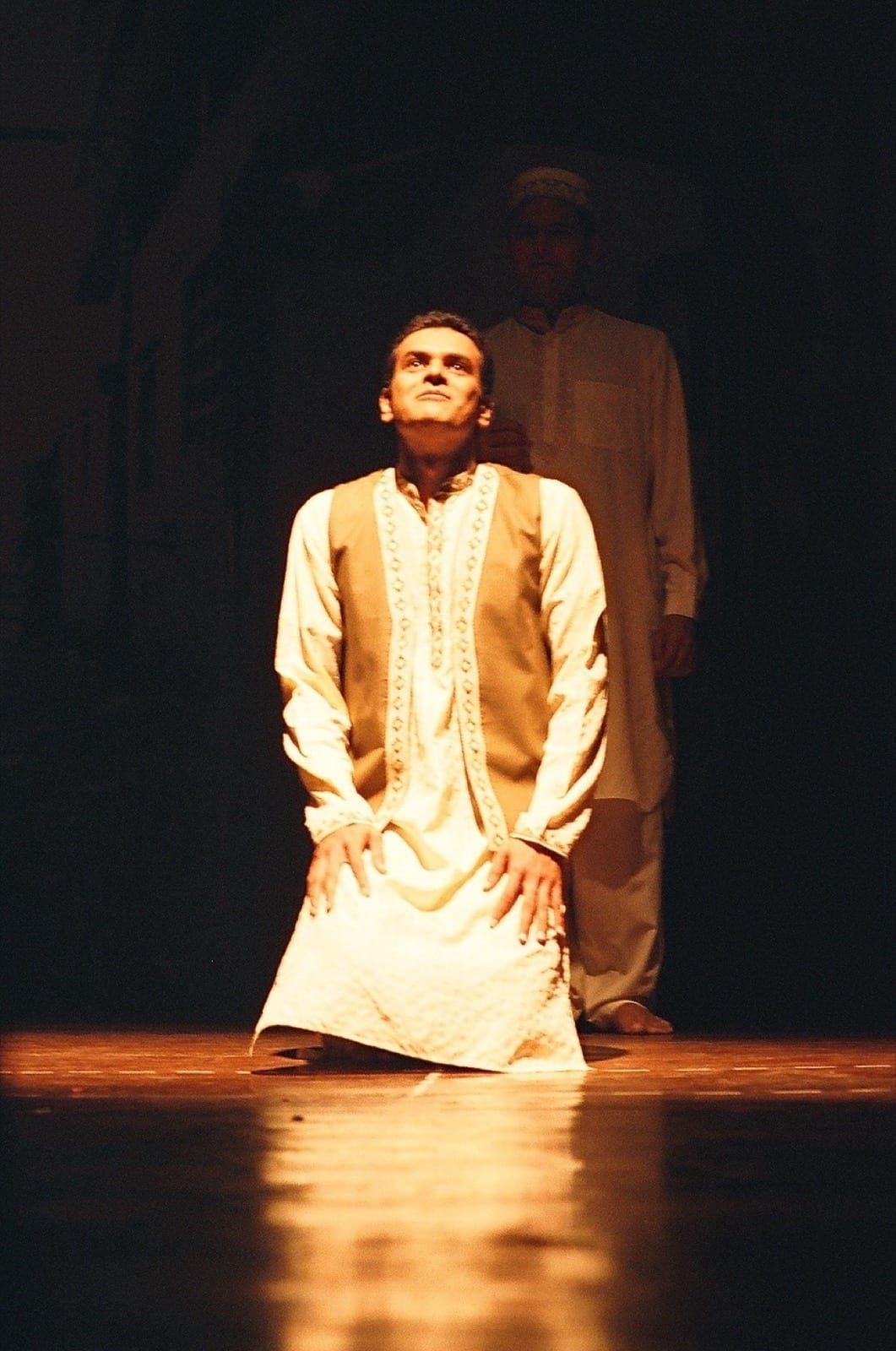
Dharmendra Gohil performs it alone. Gohil has worked with Ideas Unlimited across Bhamasha, Mareez and Amar Fal, and has a film career besides — Gandhi, My Father, 102 Not Out, Kasoombo — but the demand here is different. The play moves between Jain history, painting, literature, Western philosophy and personal memory, sometimes within a single passage, and one performer has to carry every one of those registers without a set to lean on.
What holds it together is the music. Amit Bhavsar scored the production across thirty-five cues, and they are not incidental — the play is delivered on the rhythms of music, cue running into speech and back out again. The score is the reason the material never hardens into a sermon. JAINA's own newsletter described the result as “that rare, uncanny mixture of spiritual preaching, personal narrative, philosophical lecture, and stand-up comedy — all rolled into one.”
Maitribhaav was made for the JAINA Convention 2023, the biennial gathering of the Federation of Jain Associations in North America, held in Lakeland, Florida from 30 June to 3 July on the theme “Maximize Human Potential”. It premiered there on Sunday, 2 July 2023, marking a hundred years since Chitrabhanu's birth. The choice of venue has a symmetry to it: the play about the man who first brought Jainism to America opened in front of the community he made possible. It exists in full Gujarati and Hindi versions.
The play ends where this piece began. The audience sings Maitri Bhavnu Pavitra Jharnu together — the prayer he wrote in silence as a monk, sung back to him by the people who inherited it. Most of them learned it as children without knowing whose words they were. By that point in the evening, they do.