Kamrabhabhi No Barapo: Forty Tonnes of Potatoes, and Other Evidence of Love
Gujarati is not one language so much as a set of negotiations, and the sharpest of them happens around a single letter. In the north of the state ળ softens until it is indistinguishable from ર. Kamla becomes Kamra. Kamala becomes Kamara. An entire district’s worth of women are addressed all their lives by a name that is very slightly not their own, and nobody remarks on it, because that is simply how people talk. Devanshu Pandit built a play on the slip. Kamrabhabhi No Barapo — the outcry of Kamlabhabhi — is named for a woman who cannot be called correctly in her own dialect, which turns out to be an efficient way of introducing a character nobody has ever really listened to.
There is no plot. This needs saying early, because the absence is the point. A woman comes on, and she talks. She talks while she works, which is the only way she has ever talked, and everything she says is about her husband, whom she never names. To the audience, to the neighbours, to anyone who will hold still, he is only tamara bhai — your brother. They began lower middle class. By the time he retired they had got as far as a second-hand car. The daughters are married and gone, the son works out of town, and Kamla, who has no leisure at all, is left in the flat with a man who is at home now, all day, every day.
What follows is an inventory of grievance so precise it becomes a census of devotion. Where is my towel. Where would the towel be? The clothes are washed and folded and put in the cupboard, where they have been put for thirty-seven years. He bathes, comes out, and starts again: I cannot find my glasses. Am I the one reading the newspaper, or are you? All day it is Kamra, where did you put the screwdriver, while Kamra is cutting vegetables. Everything is urgent. He has no train to catch. She is, she says, thoroughly fed up. Every sentence of the complaint is a description of a life organised end to end around one man’s comfort, and that is how the affection gets said, because it is not going to be said any other way.

Pandit keeps giving her small flourishes that let her out of the box the audience is putting her in. She quotes an advertising slogan — seedhi baat, no bakwaas — and then heads off the condescension before it arrives: you are thinking Kamrabehn knows English too. Of course she does. She was taught English by Bhoraabhai Saheb, and not by any ordinary person either. It is one line, and it establishes that the woman doing the complaining has a history, a school, a teacher she was proud of, and a clear sense of what you are assuming about her.
This is unusual territory for the company that made it. Manoj Shah has spent most of three decades directing biography — Mareez, Hu Chandrakant Bakshi, Karl Marx in Kalbadevi, Mohan No Masalo, Dr. Anandibai. Those plays come with a subject the audience can look up. Kamrabhabhi No Barapo has no famous person in it at all. Its subject is a retired couple in a flat, and its research is the kind you can only do by listening to relatives for forty years.
Then the play turns and gives the stage to the husband, and the second half of the evening is his reply.
His name, he would like the audience to know, is Harshad. Harshad Mehta. He would also like it on record that he has never in his life bought a share and has no plans to start. The joke was already a reliable one in 2016; it has only grown since, and it now sits oddly close to home — Hemant Kher, who plays the ensemble in Ideas Unlimited’s Third Bell at the NCPA, won his Gujarati Mid-Day award for playing the other Harshad Mehta’s brother in Scam 1992.
Harshad has been listening to all of it. He has been listening for years. The cotton wool he tucks into his ears every morning after his bath is not, as he tells his wife, to keep the draught out of his head; he took Best Actor prizes in college and has been giving a long, patient performance of partial deafness ever since he retired, on the reasonable grounds that a man cannot read a newspaper while being instructed to count the cooker whistles, turn off the gas and lift the lid. Somebody in the house has to know what is going on in the world. It is a responsibility.

He has also been keeping accounts. Since the wedding, by his reckoning, he has eaten at least forty tonnes of potatoes — dry potato bhaji, potato in gravy, potato with the skin on, brinjal-potato, cabbage-potato, cauliflower-potato, tindora-potato, boiled, roasted, fried, sliced lengthways, sliced across — until he had begun to resemble one. This is how he came to eat pickle, which he had never touched before marriage and which his wife now tells everyone is his great weakness. He offers the finding for general use: a household that gets through a lot of pickle is a household where the cooking has gone wrong.
The best sustained passage is the one about crying, and it shows how the script works. Harshad starts with his mother-in-law, a fusion of Nirupa Roy and Lalita Pawar, from whom Kamla inherited the trait. He moves out to the general case — a UK survey found women spend sixteen months of their lives crying; medical science says it is why they have fewer heart attacks than men; in Surat they hold competitions. He offers the technical appreciation: to cry on cue, at the chosen moment, to extract the chosen result, is an art, and to cry and talk simultaneously is a second and harder one. And then he brings it back down to the floor of his own flat with the only piece of advice in the play: when a woman starts crying, most men reach for a handkerchief. That is the mistake. Fetch her the thing she actually wants, and watch what happens.
He understands the system he lives inside better than she suspects. An evening on the balcony swing, thinking, as he puts it, like Socrates, was enough to work out the schedule: raise your voice in the morning and dinner will be late; bring home a sari and there will be mohanthal the next day. Reward and punishment. Like training a dog, he says, with the mild admiration of a man describing a well-run department. And before she goes away for any length of time she fixes his meals at her elderly aunt’s house in the same area, which keeps him off restaurant food and, more to the point, out of Bhavna’s kitchen.
Bhavna is the one place the comedy thins and something else shows through. It was almost settled between them, forty years ago; the sweets had not yet been handed round. Then his job was private-sector, her aunt produced a boy with a government post, and it broke off. Fifteen years later he got a government job himself, and by an administrative accident Bhavna’s husband and his own family were allotted quarters in the same colony. Same community, so Kamla knows the outline, and has therefore spent decades keeping half an eye on it. He finds this absurd, and he is right, and it is also the closest the play comes to admitting that both these people have been carrying something they never discussed.

Staged, it needs almost nothing: two actors, a white plastic chair, a dialect. Manoj Shah directs and plays Harshad in a red kurta and no shoes; Kalpana Shah plays Kamla and carries the bulk of the evening in a red-and-green bandhani sari and heavy black spectacles. Kanhaiya wrote the music. Janam Shah produced. The version that played at four in the afternoon at the CCI in Churchgate billed her alone on the poster, under a comic-book sunburst with her face in a thought bubble and an exclamation mark the size of her head.
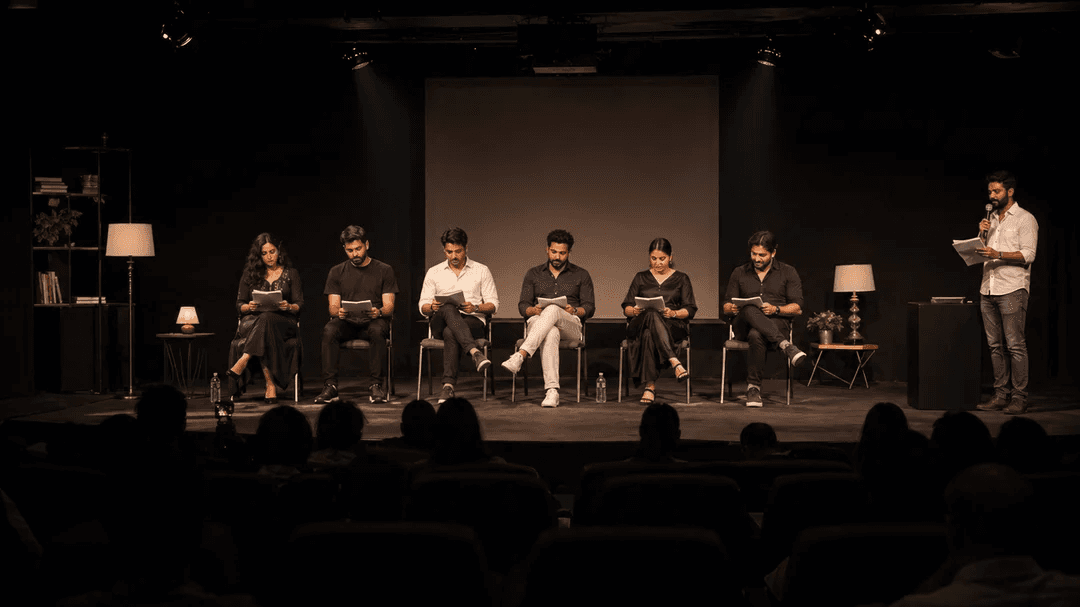
By February 2017 the house had grown. Ideas Unlimited took the play to the Hindustan Times Kala Ghoda Arts Festival — 4 to 12 February, Brinda Miller directing the festival, Juuhi Babbar Sonii curating theatre — where it was performed under Rang Savaari, the Gujarati strand. The photographs from those performances show a third figure on stage in a mustard kurta, standing between husband and wife while both talk at him: Shailesh, Kamla’s brother, fifty-seven and still not settled, who in thirty-five years has run screen printing, an STD-PCO booth, a cyber café, a milk-pouch round and a brokerage, and has brought his brother-in-law more investment plans than ICICI Bank has ever had, none of which Harshad has put a single rupee into.

Gujarati theatre has an honourable habit of putting great men on stage and explaining them. Kamrabhabhi No Barapo does the opposite, and it is harder. It takes two people that nobody would think to write about, lets each of them talk for half an evening about how impossible the other one is, and trusts an audience to work out for itself that this is what a good marriage sounds like from the inside — forty tonnes of potatoes, cotton wool in the ears, and a name that has been pronounced wrong for a lifetime by someone who would not know what to do without her.
.JPG&w=3840&q=75)